
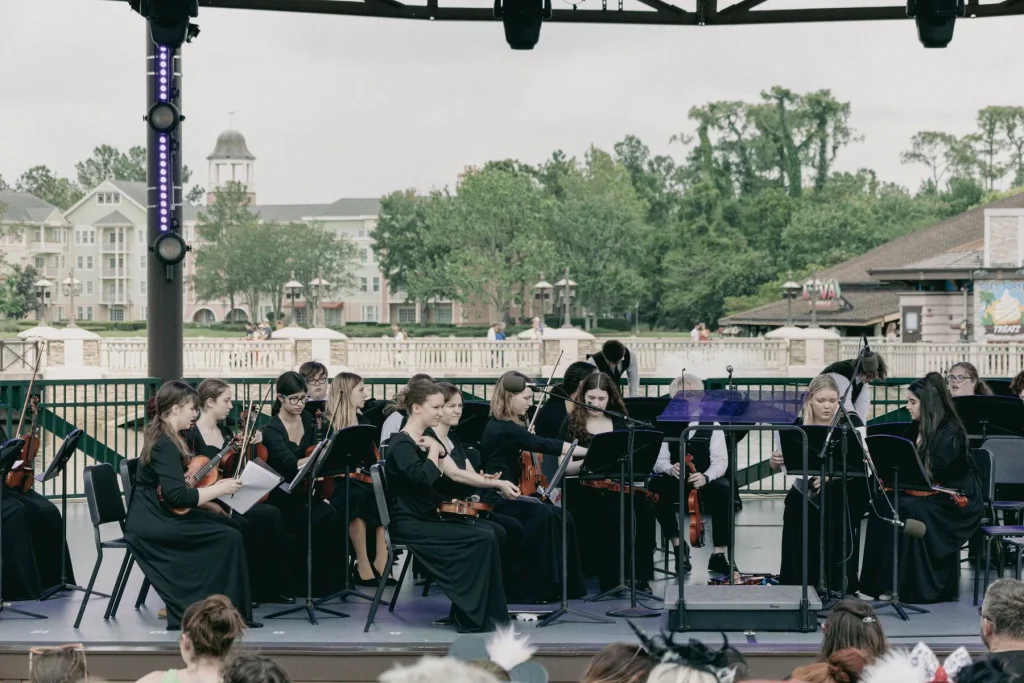
The size of a symphony orchestra varies according to many factors, such as the period, the musical work, and the availability of financial resources. Throughout music history, the size and composition of orchestras have evolved. In the 18th century, the orchestra consisted mainly of strings, with a few wind and percussion instruments.
However, in the 19th century, technological advances led to new instruments being added to the orchestra, increasing its size. In general, a modern symphony orchestra has more than eighty musicians, and sometimes more than one hundred. The orchestra’s exact composition depends on the work being performed.
The strings are the orchestra’s constant core, with the first violins occupying a hierarchical role. The winds, consisting of woodwinds and brass, can vary in number and be combined differently depending on the repertoire. Percussion is also an important part of the symphony orchestra. It is interesting to note that the size of an orchestra is often connected to economic, political, and historical considerations. In the 20th century, many orchestras had to reduce their numbers because of social and economic upheaval.
In conclusion, there is no single answer to the question of the number of musicians in a symphony orchestra, but it is a fascinating subject that reflects the evolution of music and society.
How the Size of the Symphony Orchestra Evolved Over the Centuries
In the 18th century, the size of an orchestra was determined by composers and their works, ranging from 35 musicians for Mozart to more than 1,000 performers for Mahler’s “Symphony of a Thousand.”
At the dawn of the 17th century, orchestral ensembles as we know them today did not yet exist. The first “orchestras” were instead groups of various instruments, used mainly to provide accompaniment for opera and theater. It was not until the middle of the 18th century that the form of the symphony orchestra began to become established and expand with the addition of oboes, bassoons, horns, trumpets, and timpani.
The Classical period saw wind instruments paired, while the Romantic period introduced the systematic addition of new instruments such as the piccolo, English horn, bass clarinet, contrabassoon, trombones, and tuba. Percussion also underwent considerable development during this period. By the beginning of the 20th century, symphony orchestras could have more than eighty musicians and sometimes over one hundred instrumentalists.
The size of a symphony orchestra depends primarily on its funding. In the 20th century, many orchestras were forced to reduce their numbers because of the period’s political and economic upheavals. Despite these restrictions, however, composers continued to write for more modest orchestral forces.
In conclusion, the size of the symphony orchestra changed significantly over the centuries, developing from more modest ensembles into much larger formations. This evolution was influenced by technological advances, economic constraints, and composers’ aesthetic choices.
The Expansion of the Symphony Orchestra in the 19th Century
In the 19th century, the symphony orchestra expanded considerably with the introduction of new instruments such as the piccolo, English horn, bass clarinet, and percussion instruments. Technological advances in instrument making enabled this development.
The brass section also developed through the use of valves. Orchestras grew larger, often comprising more than eighty musicians and sometimes over one hundred. Concert halls were also enlarged to meet growing public demand. This expansion was encouraged by the invention of the telephone, which made it possible to transmit music to different cities and countries.
The composition of orchestras was influenced by composers of the period, such as Beethoven, Brahms, Wagner, and Mahler, who wrote for larger forces and added new instruments to the orchestra, including saxophones, trombones, and the tuba. Percussion also underwent considerable development during this period.
At the beginning of the 20th century, however, symphony orchestras faced financial and political difficulties, resulting in reductions in their numbers. For economic reasons, composers were forced to write for more modest forces.
Even with these changes, the symphony orchestra remained an important institution, performing symphonic, concertante, and sacred works in concert halls. It was also used to accompany opera and dance performances and to perform film and video-game music.
A symphony orchestra comprises three families of instruments: strings; winds, which include woodwinds and brass; and percussion. Each section has a principal player, who may be assisted by a second or third principal. The concertmaster plays an important role in the orchestra, sometimes representing the ensemble before the conductor and the audience.
The arrangement of the sections can vary according to the work and the layout of the concert hall. The strings are generally arranged in a semicircle from left to right, with the first violins on the left and the double basses on the right. The winds may be arranged in rows or blocks, which helps the sections listen to one another. Percussion instruments are also present in the orchestra and add a diverse range of sounds.
The changes and expansion of the symphony orchestra in the 19th century contributed to its development as a musical institution and enriched its repertoire.
The Symphony Orchestra in the 20th Century and Fluctuations in Its Size
In the 20th century, the orchestra’s development depended largely on financial considerations, with periods in which ensemble sizes were reduced because of economic and political upheaval. The size of the symphony orchestra fluctuated throughout the century. Orchestras were forced to reduce their numbers during the world wars. During this period, many cities had to close their symphony orchestras because of a lack of funding. The costs of maintaining instruments and paying musicians forced orchestras to make budget cuts.
The 1960s and 1970s brought another period of reductions in the size of symphony orchestras because of the economic crisis affecting the United States and Europe. Orchestras had to reduce their numbers because public subsidies declined.
In the 1980s and 1990s, however, symphony orchestras experienced a revival and an increase in funding thanks to rising private donations. Orchestras were able to increase both the number of musicians and their artistic quality. Nevertheless, the size of the symphony orchestra remains influenced by economic and aesthetic factors.
The size of a symphony orchestra is determined by the complexity and nature of the work to be performed. Today, the size of a symphony orchestra generally ranges from 75 to 100 musicians, although smaller and larger ensembles also exist. The orchestra is generally organized around three families of instruments: strings; winds, which include woodwinds and brass; and percussion. Violins, violas, cellos, and double basses form the string section. The winds include flutes, clarinets, oboes, bassoons, and brass instruments such as trumpets and trombones. The percussion section includes a variety of instruments such as timpani, cymbals, and the xylophone.
Exact Composition of a Modern Symphony Orchestra
The exact composition of a modern symphony orchestra includes three families of instruments: strings; winds, which comprise woodwinds and brass; and percussion. The strings are the most consistent part of the orchestra and include first violins, second violins, violas, cellos, and double basses.
The winds, which are generally positioned behind the strings, consist of flutes, oboes, clarinets, and bassoons. The number of woodwinds can vary according to the repertoire, but each type of instrument forms a separate section.
Finally, percussion completes the orchestra and includes a variety of instruments such as timpani, drums, cymbals, and xylophones.
The size of an orchestra can also vary, with some orchestras comprising more than 100 musicians. The exact composition of a modern symphony orchestra, however, depends on many factors, such as the work to be performed and the conductor’s choices.
Conclusion
In conclusion, the exact size of a symphony orchestra depends on many factors, but it is common for the ensemble to exceed 80 musicians. The size and composition of symphony orchestras have evolved considerably throughout music history. In the 18th century, orchestras were often small, with around 35 musicians, as in Mozart’s orchestra. By the 20th century, however, technological advances and the expansion of concert halls had made orchestras larger, sometimes exceeding 100 musicians.
The size of an orchestra depends primarily on its funding and resources. Symphony orchestras consist mainly of strings, woodwind and brass instruments, and percussion. Each section includes a principal player accompanied by rank-and-file musicians, and the concertmaster occupies a hierarchical role as the orchestra’s representative.
The arrangement of the different sections can vary according to the orchestra’s configuration, but strings are generally arranged in a semicircle, winds may be arranged in rows or blocks, and percussion usually occupies the rear of the orchestra.
Symphony orchestras are used primarily to perform symphonic and concertante works in concert halls and to accompany operas, ballets, and other choreographic productions. They are also used to record film and video-game music.
In conclusion, the size and composition of a symphony orchestra are determined by the evolution of music, technological advances, financial resources, and the requirements of the works to be performed.
Source Links
- https://en.wikipedia.org/wiki/Musical_ensemble
- https://www.khanacademy.org/humanities/music/music-instruments-orchestra
- https://en.wikisource.org/wiki/Instruments_of_the_Modern_Symphony_Orchestra
- https://eso.co.uk/history/
- https://www.mso.com.au/learning/schools-and-teachers/mso-learn
- https://clarkrundell.com/orchestra/instruments-of-the-orchestra/
- https://classicalunpacked.com/instruments/orchestra-seating/
- https://www.myhso.org/blogs/how-many-instruments-are-in-a-symphony-orchestra-a-complete-guide
- https://journals.openedition.org/itti/846?lang=en