
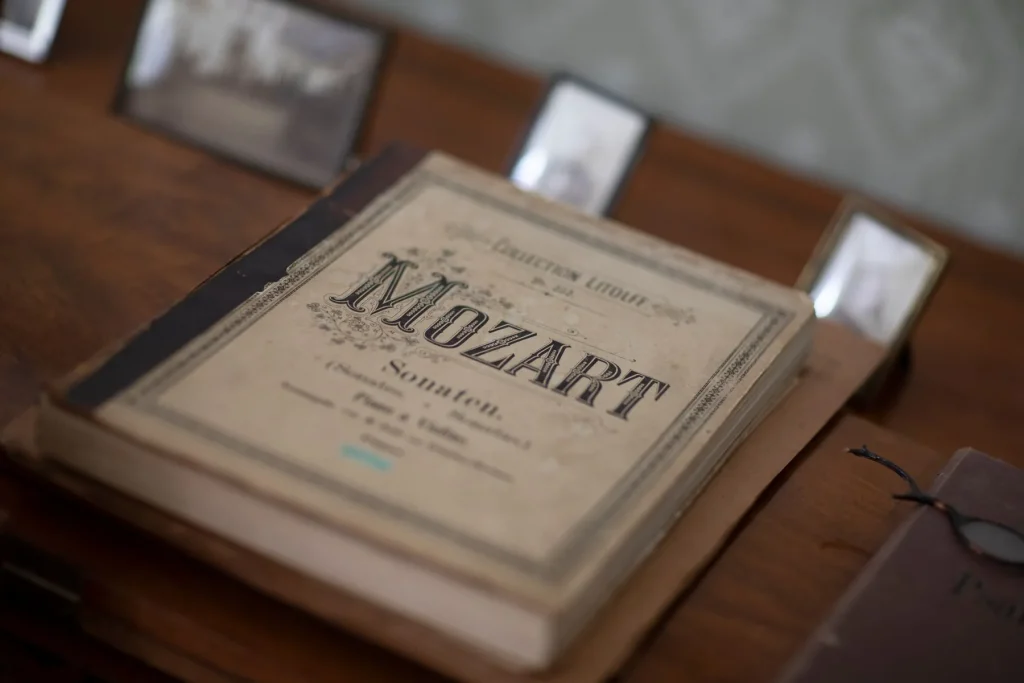
The question of this fascinating composer’s hearing health has intrigued classical music lovers for decades. Strangely, the idea that he suffered from deafness is widespread, but it deserves to be examined critically. A great deal of medical speculation circulated after his death, and deafness is just one example among more than 120 proposed diagnoses.
Wolfgang Amadeus Mozart, recognized as a musical genius, demonstrated an exceptional ear from a very young age. Indeed, he is said to have had perfect pitch at the age of three, which contradicts the deafness hypothesis. His music displays an impressive mastery of harmony, making this idea particularly paradoxical.
In this article, we will separate fact from fiction using medical records and contemporary accounts. We will explore the life of this iconic composer, analyze the rumors of deafness, and examine the illnesses from which he actually suffered. This will allow us to better understand the myth’s impact on his legacy.
Introduction: understanding the myth of Mozart’s deafness
The fascination with this iconic composer’s hearing health raises many questions. The idea that he suffered from deafness is deeply rooted in the collective imagination, but its origins deserve to be explored. This perception has been strongly influenced by romanticized narratives and misinterpretations that emerged over the centuries.
To better understand this myth, it is essential to trace its origins. The idea that this exceptional artist was deaf took root in the nineteenth century, thanks to figures such as Carl Gollmick. He emphasized the childlike innocence of Mozart’s personality, suggesting that it shed light on his works. However, this romantic image does not necessarily correspond to historical reality.
Indeed, medical literature helped turn Mozart’s biography into an almost encyclopedic catalogue of ailments. Diagnoses such as labyrinthitis and alleged deafness in the left ear were put forward without tangible evidence. These claims shaped an image of him as a fragile, angelic Baroque musician, like a Saxon porcelain doll.
This confusion with other composers, such as Beethoven, who genuinely lost his hearing, fueled the misconception. For music lovers, separating fact from fiction about this artist’s hearing health makes it possible to appreciate his work in all its complexity.
It is crucial to understand that the persistence of this myth reveals our relationship with culture. We tend to romanticize artists’ suffering, often associating creative genius with physical disabilities. This investigation into the reality of his hearing health has profound implications for contemporary musicology.
Ultimately, exploring these misconceptions allows us to better grasp this artist’s musical legacy and appreciate the depth of his genius within the historical context of his era.
Mozart’s life and career: an apparently healthy musical genius
The life of Wolfgang Amadeus Mozart, a master of music, was marked by early success and generally good health. Born in Salzburg in 1756, he displayed perfect pitch from the age of three. This ability enabled him to memorize a vast number of sounds, even before he learned to read or write.
A prodigious childhood and musical education
His father, Leopold, was a musician and music teacher. He taught him the harpsichord from the age of five. With remarkable rigor, he introduced his son to musical composition. At only six years old, Wolfgang composed his first works, including five minuets and a sonata, which immediately earned him fame throughout Europe.
Between 1762 and 1766, Leopold organized an extensive European tour. This four-year journey through Europe’s greatest cities allowed the child prodigy to impress royal courts. He even met Johann Sebastian Bach’s youngest son, who taught him the fundamentals of constructing a symphony.
Adult life, travel, and physical health
During his lifetime, Wolfgang Amadeus lived for 13,097 days and spent 3,220 days traveling. That represents nearly one-third of his life. Despite these numerous journeys, he was in excellent physical health. Contrary to the fragile image often conveyed by popular anecdotes, he endured airborne, waterborne, and foodborne infections without major lasting effects.
At the age of 11, he composed his first opera, Apollo and Hyacinthus. At 14, during a trip to Italy, he transcribed Allegri’s Miserere from memory after hearing it only once in the Sistine Chapel. This feat demonstrates his exceptional auditory abilities and unerring ear.
Family relationships and influences
Wolfgang’s family relationships were complex. His father Leopold opposed his marriage to Constanze Weber in 1782. This created distance between father and son, who would see each other only twice more before Leopold’s death in 1787.
As a man of his time, he was also a Freemason, initiated in 1784 at the Beneficence lodge. His fondness for jokes and wordplay is apparent in his correspondence, particularly with his cousin Maria Anna Thekla. His official name was Joannes Chrysostomus Wolfgangus Theophilus Mozart, but he enjoyed distorting his identity by calling himself Trazom or Mozartini.
Analyzing misconceptions about Mozart’s hearing health
The myths surrounding this composer’s hearing health have persisted through the centuries. It is crucial to examine these rumors critically. Indeed, the lack of tangible evidence in primary sources calls into question the idea that he suffered from deafness.
Rumors of deafness and their absence from primary sources
Claims about alleged deafness in the left ear or labyrinthitis are often repeated without any basis. Most authors who support these ideas rely on secondary sources without consulting the original documents written in eighteenth-century German. This chain of errors has led to a distorted perception of reality.
Letters and accounts from the period mention no hearing problems. This includes personal correspondence in which he never complains about such an issue. Contemporaries such as Haydn praised his genius without ever mentioning any hearing impairment.
Examining historical and medical accounts
It is worth noting that this composer possessed perfect pitch, enabling him to identify and reproduce any musical note. This talent makes the hypothesis of a hearing impairment particularly implausible. At 14, he transcribed Allegri’s Miserere from memory after hearing it only once, a feat that demonstrates his exceptional auditory faculties.
A critical analysis of historical sources reveals that contemporary accounts describe a man in full possession of his senses. Even at the end of his life in 1791, there is no indication of any hearing disorder. In short, the rumors of deafness are later constructions with no foundation in contemporary historical records.
| Evidence | Primary sources | Secondary sources |
|---|---|---|
| Deafness in the left ear | Absent | Present |
| Labyrinthitis | Absent | Present |
| Contemporary accounts | Positive | Negative |
| Personal correspondence | No complaints | Includes speculation |
In conclusion, an examination of the available sources leaves no room for doubt. The rumors of deafness are unfounded and reflect our romanticized view of genius. To explore this analysis further, you can consult additional resources on perfect pitch.
Illnesses attributed to Mozart: facts, hypotheses, and controversies
The health of this composer, which has often been called into question, deserves an in-depth analysis of the diagnoses attributed to him. More than 120 causes of death have been proposed. These hypotheses range from fever to more serious diseases.
Proposed historical and modern medical diagnoses
Historical diagnoses include a variety of conditions, often without a solid basis. Some of the illnesses attributed to him include:
- Rickets
- Pellagra
- Syphilis
- Temporal lobe epilepsy
- Hydrocephalus
These diagnoses often owe more to speculation than to medical reality. Indeed, medical literature transformed his biography into an encyclopedia of diseases without tangible evidence.
A critical assessment of conflicting medical hypotheses
The established facts about his health are quite different. At the age of six, he suffered from erythema nodosum. At ten, he experienced a brief episode of joint pain in his feet and knees. At 11, he contracted smallpox. His health remained generally excellent until November 20, 1791.
On that day, he suddenly became bedridden, with no warning signs. His illness progressed rapidly, causing severe weakness and edema. He also experienced projectile vomiting and probably developed a fever toward the end. Despite this, he remained conscious and active until shortly before his death.
His attending physician, Dr. Closset, diagnosed a “deposito alla testa,” a period expression for a state of delirium caused by a high fever. The death certificates mention “Hitziges Frieselfieber,” a generic term with no precise medical meaning.
The two most plausible hypotheses among the 140 proposed causes of death are kidney failure and rheumatic fever. Poisoning, long suggested as a possibility, belongs more to legend than to documented historical reality.
It is important to remember that this composer died on December 5, 1791, at the age of 35, conscious and content until shortly before the end. This contradicts the romantic image of a man overwhelmed by illness and writing his Requiem in agony.
Was Mozart deaf? What the sources reveal about this common misconception
Wolfgang Amadeus Mozart’s hearing health is a subject that sparks passionate debate. It is essential to examine medical documents and contemporary writings to clarify the question. Historical sources are crucial to dispelling these misconceptions.
Analysis of medical documents and contemporary writings
Analyses of the medical records show that this composer displayed no signs of a hearing disorder. Contemporary writings, including his extensive correspondence, testify to a daily life free from hearing problems. This evidence provides decisive grounds for definitively rejecting the myth of his deafness.
Ernest Friedman, an eminent neurologist, attempted to argue that Mozart suffered from musical dysphasia, a mild form of musical aphasia. However, there is no evidence to support this hypothesis. Although critical analyses of the primary sources vary, they show that claims of hearing disorders are unfounded.
The perspective of musicologists and neurologists
Musicologists emphasize that Mozart’s music displays an exceptional mastery of harmony and tonal nuance. It would be inconceivable for a composer of this caliber to suffer from deafness, even partial deafness. His ability to compose complex works demonstrates that his hearing was in perfect health.
Moreover, Mozart’s auditory abilities are well documented. At the age of 14, he transcribed Allegri’s Miserere after hearing it only once. This achievement demonstrates his perfect pitch, a rare ability that allowed him to identify any note instantly.
The historical reality is unequivocal: Mozart was a man in full possession of his auditory faculties. Rumors of deafness stem from confusion with other composers or from unfounded medical speculation. It is time to put this myth to rest, as it does not withstand a critical examination of the available documents.
| Evidence | Primary sources | Secondary sources |
|---|---|---|
| Deafness | Absent | Present |
| Musical dysphasia | Absent | Present |
| Contemporary accounts | Positive | Negative |
| Personal correspondence | No complaints | Includes speculation |
In conclusion, this composer’s work, through its richness and harmonic complexity, provides the best evidence of the integrity of his ear and auditory faculties throughout his life. To learn more about his musical genius, you can read this article about Wolfgang Amadeus Mozart.
The impact of the deafness myth on perceptions of Mozart and his music
The myth surrounding this composer’s hearing health has left a lasting mark on our perception of his genius. Although this idea is unfounded, it reinforced the romantic image of a tortured artist isolated by an imaginary sensory disability.
In popular culture, this myth has produced a variety of portrayals. In film and literature, he is often depicted as fragile and sickly. This contrasts with the historical reality of a lively, cheerful, and healthy man.
This distorted image has influenced interpretations of his work. Some musicians adopt a delicate, ethereal style that fails to do justice to the vigor and dynamism of his compositions, particularly in operas such as Don Giovanni.
Works such as The Magic Flute, composed in 1791, demonstrate this composer’s intellectual and symbolic depth. Initiated into the Beneficence Masonic lodge in 1784, he was far removed from the superficial image of a drawing-room composer often conveyed by popular anecdotes.
The myth of deafness is part of a broader tendency to romanticize the suffering of great men. This obscures our understanding of the real history of music and the people who shaped it. The persistence of this misconception reveals our need for dramatic narratives.
It is also interesting to note that even this composer’s name was transformed after his death. He never used the name Amadeus during his lifetime, illustrating how posterity reconstructs the image of great men according to its own expectations.
In conclusion, debunking this composer’s supposed deafness allows us to rediscover his work in all its richness. It helps us shed the clichés that have long weighed on its interpretation and on the perception of classical music as a whole.
| Elements | Impact on perception | Examples in popular culture |
|---|---|---|
| Myth of deafness | Reinforces the romantic image of a tortured genius | Films and literature |
| Media portrayals | Depicts him as fragile and sickly | Adaptations of his works |
| Influence on interpretation | Delicate, ethereal style | Interpretations of Don Giovanni |
| Name and image | Posthumous transformations | Use of the name Amadeus |
How to demystify Mozart: tools for rethinking common misconceptions
The complexity of this composer’s musical legacy demands a rigorous approach to separating myth from reality. To do so, historical and medical sources must be examined critically.
A critical approach to historical and medical sources
To understand this artist’s history, it is crucial to consult the eighteenth-century German primary documents. Most authors rely on often inaccurate secondary sources that propagate myths such as his supposed deafness.
Here are some steps for approaching these sources:
- Read the original letters and correspondence to understand the context of his era.
- Compare contemporary accounts to establish a balanced view.
- Analyze the period’s medical terminology to avoid inappropriate modern interpretations.
The role of advances in history, musicology, and medicine
Advances in modern musicology allow us to better understand the context in which the works were composed. Researchers such as Alfred Einstein helped clarify established facts and distinguish them from the legends accumulated over time.
Medical advances also help reassess the diagnoses attributed to him. Terms such as “Hitziges Frieselfieber” or “deposito alla testa” must be interpreted in their historical context.
Tips for an informed appreciation of his musical genius
To fully appreciate this artist’s talent, it is advisable to listen carefully to his major works, such as:
- The Magic Flute
- Symphonies Nos. 40 and 41
- Operas such as Don Giovanni
These compositions reveal the scope of his genius, far removed from the myths that may have distorted our perception.
It is also important to recognize that, despite his genius, this man experienced financial difficulties. The debts he accumulated with people close to him, such as Prince Lichnowsky, make him more human and relatable.
In conclusion, an in-depth knowledge of this artist’s real life enriches our appreciation of his music. His works were not the product of disembodied inspiration, but the work of a musician rooted in his time, with all its joys and sorrows.
To go further, feel free to consult Mozart’s complete correspondence, edited by Geneviève Geffray, to better understand the family dynamics that shaped his musical genius.

Conclusion: Mozart, his hearing health, and the end of the misconceptions
In conclusion, the exploration of this composer’s hearing health continues to fuel debate among music lovers. Contemporary accounts and the absence of tangible evidence confirm that he never suffered from deafness. His death on December 5, 1791, at the age of 35 gave rise to numerous medical hypotheses, but none mentions any connection to hearing problems.
This man’s genius lay in his exceptional mastery of music, made possible by perfect pitch. He composed more than 620 works, including The Magic Flute, an iconic opera, while retaining good hearing until the end of his life.
Debunking misconceptions about his health allows us to better appreciate his musical legacy. Every music lover is invited to listen to his works with fresh ears, free from prejudice, and discover the richness of his genius. To deepen your knowledge, consult Mozart’s complete correspondence.