
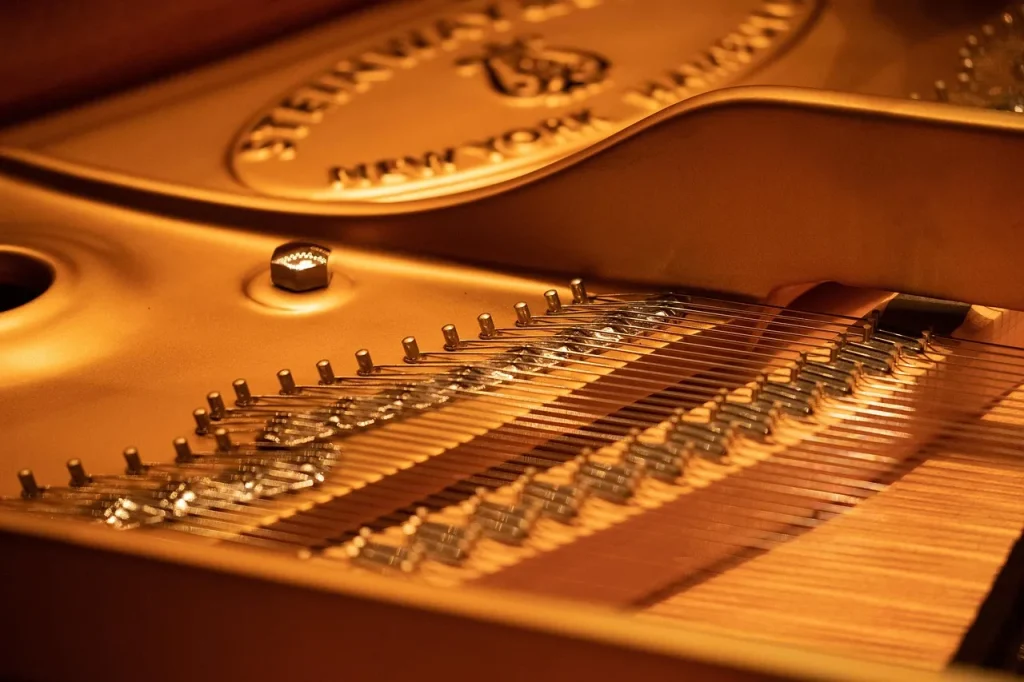
Mastering Claude Debussy’s compositional techniques is an exciting challenge for any musician. This unique style, characterized by fluid arpeggios and proper posture, calls for a methodical and consistent approach.
Debussy’s Études are often used as a teaching foundation for understanding his musical vision. They help develop precision and expressiveness, two key elements of his work.
Regular practice is essential for making progress. Modern tools such as the Newzik app can make learning easier by providing interactive, tailored resources.
Introduction to Debussy-Inspired Composition
Immerse yourself in the world of classical music through Claude Debussy’s innovative approach. His unique style left its mark on the history of composition, influencing generations of composers.
Debussy drew inspiration from the techniques of Chopin and Liszt. These piano masters shaped his vision, enabling him to develop a rich and expressive harmonic language.
The evolution of French music owes much to Debussy. His repertoire introduced innovations that redefined the standards of his time. The First World War also played a key role in his late work, which reflects the tensions and emotions of that period.
The Études, CD 143 are an artistic testament to his genius. These pieces explore complex techniques while retaining a timeless beauty. To learn more about methods of musical composition, see this resource.
The Foundations of Debussy’s Technique
Exploring the foundations of Debussy’s technique reveals the richness of his music. This approach rests on key elements that shape his unique, fluid style.
The Importance of Arpeggios
Arpeggios play a central role in melodic fluidity. They develop finger agility and improve coordination between the hands. Debussy used them to create rich, expressive textures.
To master this technique, practicing specific exercises is recommended. The sheet music available on Newzik offers interactive methods for coordinating the hands effectively.
Coordination Between the Left and Right Hands
Synchronization between the left hand and the right hand is essential. It enables precise, fluid playing, especially in complex passages.
Debussy’s Études include exercises for the five fingers that are ideal for strengthening this coordination. Compared with Chopin’s techniques in the Nocturnes, they emphasize muscular relaxation while playing.
Ultimately, regular, mindful practice is the key to incorporating these elements into your playing. It will help you move closer to Debussy’s unique style.
Understanding Chord Structure
Learning about the structure of chords is essential to understanding the music of Claude Debussy. Seventh and ninth chords, which Debussy often used, create complex harmonic textures. These chords add emotional depth to his compositions.
Harmonic decomposition makes it possible to analyze every note in a chord. Playing a chord as an arpeggio helps you visualize each note and better understand its shape. This method is particularly useful when interpreting works such as Clair de Lune.
In Clair de Lune, Debussy uses chords to evoke a dreamlike atmosphere. Chord structure directly influences the musical emotion they convey. To learn more about musical scales, see this resource.
| Chord Type | Example | Emotion |
|---|---|---|
| Seventh chord | Clair de Lune | Melancholy |
| Ninth chord | Prelude to the Afternoon of a Faun | Mystery |
Modern compositions often draw inspiration from Debussy’s techniques. By mastering chord structure, you can enrich your own musical style. This approach enables you to create works that are both complex and expressive.
Posture and Hand Position
Good posture and proper hand positioning are essential for playing the piano with ease. They reduce the risk of injury and improve fluidity.

Adopting Correct Piano Posture
For optimal posture, your elbows should be level with the keyboard and your wrists should remain supple. This position promotes a more efficient flow of energy and reduces muscle fatigue.
Ergonomic principles inspired by Debussy’s manuscripts emphasize comfort and efficiency. A comparison of traditional and modern posture reveals notable differences in approaches to playing.
Finger Position for Greater Fluidity
Finger position is crucial for playing accurately. The thumb plays a key role in movement, enabling smooth transitions between notes.
Specific exercises help strengthen coordination and prevent tendinitis. Regular practice of these techniques improves mastery of the keyboard.
| Aspect | Advice | Benefit |
|---|---|---|
| Posture | Elbows aligned, wrists supple | Reduced fatigue |
| Fingers | Natural position, active thumb | Fluid playing |
| Risk | Avoid muscle tension | Injury prevention |
Arpeggios: Where Technique Meets Creativity
Arpeggios open the door to a wide variety of sound worlds. They make it possible to create distinctive atmospheres suited to every musical style. In *Pelléas et Mélisande*, Claude Debussy uses broken arpeggios to evoke a mysterious, poetic atmosphere.
Adapting arpeggios to jazz, inspired by Newzik’s advice, demonstrates their versatility. These techniques make it possible to play with nuance and create innovative textures. Arpeggios thus become an essential tool for expressing creativity.
A comparative analysis with the *Preludes* reveals how Debussy explores rhythmic variations. These compositions illustrate the richness of arpeggios and their ability to transform a melody.
Arpeggios create atmosphere in every musical genre.
Finally, demonstrations of rhythmic variations show how arpeggios can enrich a work. They add a dynamic and emotional dimension, making them a key element of modern music.
Practical Exercises for Mastering Arpeggios
To improve your piano playing, arpeggios are a key element to master. They develop fluidity and precision while enriching your musical repertoire. Here are some practical exercises to help you progress.
Basic Arpeggios in Major and Minor Keys
Begin with simple keys, such as C major and A minor. The C–E–G–E–C exercise, ascending and descending, is ideal for beginners. Repeat this sequence for 15 minutes a day to strengthen your agility.
Use a metronome, such as the one in Newzik, to maintain a steady beat. Gradually move on to more complex chords, alternating between major and minor chords. This practice will help you better understand harmonic nuances.
Hand-Crossing Exercises
Crossing the hands is an advanced technique that requires coordination. Draw inspiration from Étude CD 143 to master this method. Begin slowly, concentrating on synchronization between the two hands.
For sixths, practice specific sequences drawn from the Études. These practical exercises will help you develop natural fluidity. Remember to release muscle tension to avoid fatigue.
| Exercise | Goal | Duration |
|---|---|---|
| C–E–G–E–C | Finger agility | 15 min per day |
| Hand crossing | Coordination | 10 min per day |
| Major and minor chords | Harmonic nuances | 20 min per day |
Developing Speed and Precision
Improving speed and precision at the piano requires a structured, methodical approach. Both are essential for performing complex works with fluidity and expressiveness.
Progressive acceleration techniques inspired by Liszt are an excellent starting point. Begin slowly, concentrating on the accuracy of each note, then gradually increase the tempo. This strengthens coordination and reduces the risk of errors.
Managing arm weight is also crucial. Relaxed posture and fluid arm movement promote greater precision while preventing muscle tension. Practice specific exercises to develop this agility.
Debussy’s Études provide concrete examples for practicing octaves. Analyze these pieces to understand how to incorporate rapid passages while maintaining high speed. This will help you master advanced techniques.
Finally, avoid common mistakes such as forcing the fingers or neglecting tempo. Regular, mindful practice is the key to progressing without excessive effort.
| Exercise | Goal | Advice |
|---|---|---|
| Progressive acceleration | Improve speed | Begin slowly, then accelerate gradually |
| Arm-weight management | Reduce tension | Maintain a relaxed posture |
| Octave analysis | Precision in rapid passages | Study Debussy’s Études |
Incorporating Arpeggios into Pieces
Incorporating arpeggios into a musical piece adds a unique expressive dimension. These techniques create rich, captivating textures suited to various musical styles.

Consider the example of The Girl with the Flaxen Hair by Claude Debussy. This piece uses fluid arpeggios to evoke a light, poetic atmosphere. Studying this piece reveals how arpeggios can enrich a melody.
Here are a few techniques for incorporating arpeggios into your performances:
- Ornamentation: add passing notes to embellish repeated sections.
- Dynamic variations: adapt the arpeggios to the nuances marked in the score.
- Annotations: use tools such as Newzik to annotate scores and personalize your playing.
Finally, feel free to experiment as you develop your personal style. Arpeggios offer tremendous creative freedom, allowing you to transform a simple melody into a rich, moving work.
Debussy’s Influence on Classical Music
The influence of Claude Debussy redefined the landscape of classical music. His innovative approach left its mark on the history of composition and inspired generations of composers.
Debussy profoundly influenced major figures such as Maurice Ravel and Igor Stravinsky. Ravel adopted his harmonic language, while Stravinsky explored similar textures in his works. This influence also extends to modern composers such as Pierre Boulez and Olivier Messiaen, who incorporated his ideas into their creations.
A comparison with Johann Sebastian Bach reveals similarities in compositional structure. Both used complex forms to express profound emotions. However, Debussy broke with the Germanic tradition, introducing a harmonic revolution that redefined the French repertoire.
In his 1915 article “At Last, Alone!” Debussy expresses his vision of music liberated from convention. This thinking influenced his approach and marked a break with established norms. His legacy continues to shape contemporary music, offering an inexhaustible source of inspiration.
Debussy paved the way for a new musical era in which expressiveness takes precedence over rigid forms.
Finally, his impact on French music after Rameau is undeniable. He redefined its standards, creating a bridge between the past and the future. His work remains a touchstone for musicians and lovers of classical music.
Debussy’s Études: A Source of Inspiration
The 12 Études by Claude Debussy are a treasure trove of pianistic techniques. Composed in 1915, they embody harmonic and rhythmic innovation that left its mark on music history. This collection is a perfect example of how Debussy pushed the boundaries of the piano.

A structural analysis of the two books of Études reveals a diversity of forms and styles. Each étude explores a specific technique, such as arpeggios, octaves, or repeated notes. These elements allow pianists to develop their agility and expressiveness.
The Étude for Repeated Notes is a textbook case. It demands exceptional precision and endurance. Marguerite Long, the celebrated pianist, testified to the rigor Debussy demanded in performances of this piece. She also emphasized the importance of the pedal in creating unique sonic effects.
Debussy’s Études are an inexhaustible source of inspiration for modern pianists.
Pedaling techniques inspired by the manuscript scores add an expressive dimension to these works. They make it possible to create subtle nuances and varied atmospheres. This approach has influenced many contemporary composers, who incorporated these methods into their own creations.
| Étude | Technique | Impact |
|---|---|---|
| For Repeated Notes | Precision and endurance | Strengthens agility |
| For Arpeggios | Fluidity and coordination | Improves expressiveness |
| For Octaves | Speed and power | Develops technique |
Finally, the legacy of Claude Debussy continues to inspire musicians. His Études remain a touchstone for anyone seeking to master pianistic techniques while exploring new musical possibilities.
The Benefits of Arpeggios for Pianists
Arpeggios offer significant benefits to pianists, both technically and creatively. They help develop a better understanding of harmony, which is essential for interpreting complex works.
Practicing arpeggios strengthens muscle memory, a key element of fluid playing. This practice also helps prevent injury by encouraging relaxed, natural playing.
In jazz, arpeggios are widely used for improvisation. They offer creative freedom, enabling pianists to explore a variety of textures. A comparative study shows notable progress after three months of regular practice.
- Development of muscle memory
- Application to jazz improvisation
- Injury prevention through relaxed playing
Testimonials from professionals confirm the positive impact of arpeggios on mastery of the keyboard. To learn more about understanding harmony, see this resource.
| Benefit | Impact |
|---|---|
| Muscle memory | Fluid playing |
| Jazz improvisation | Creative freedom |
| Injury prevention | Relaxed playing |
Tips for Making Rapid Progress
The secret to rapid progress lies in organized practice. To achieve your goals, it is essential to adopt effective methods and remain consistent in your efforts.
Practice Regularly
Consistent work is the key to moving forward. Schedule daily sessions of 10 to 15 minutes, using a metronome to improve your rhythm. This approach strengthens agility and precision.
Here are some tips for optimizing your practice:
- Create a practice schedule to track your sessions.
- Record your performances to analyze your progress.
- Set clear goals for each session.
Use a Metronome
A metronome is an indispensable tool for improving your sense of rhythm. Begin slowly, then gradually increase the tempo. This will help you play with greater fluidity and precision.
As a practical exercise, study the Étude for Thirds. This piece is ideal for working on coordination and speed. Analyze your scores to identify passages that need improvement.
Consistency and method are the pillars of rapid progress.
| Advice | Goal |
|---|---|
| Planning | Track practice sessions |
| Recording | Analyze performances |
| Metronome | Improve rhythm and precision |
Finally, to deepen your knowledge, consult this resource to learn piano. It will guide you on your musical journey.
Exploring New Styles with Arpeggios
Beyond their technical value, arpeggios open up unexpected sonic horizons. They make it possible to blend varied styles, thereby enriching your musical repertoire. This flexibility is an asset for pianists seeking to innovate.
Adapting Debussy’s techniques to progressive rock is a fascinating example. Debussy’s fluid arpeggios pair perfectly with rock’s complex rhythms, creating a unique fusion. This approach shows how classical music can inspire modern genres.
The fusion of classical and electronic music through arpeggios is another path to explore. By using innovative pedal effects, you can transform traditional melodies into contemporary works. This creativity opens new possibilities for performers and composers.
Modern covers of classical pieces illustrate this stylistic transition. By incorporating arpeggios into contemporary arrangements, musicians breathe new life into timeless works. These adaptations demonstrate the versatility of Debussy’s techniques.
Here are a few tips for making these transitions successfully:
- Experiment with varied tempos and keys.
- Use pedal effects to add nuance.
- Study examples of covers to understand the techniques used.
Ultimately, arpeggios remain a powerful tool for exploring new musical horizons. Their flexibility and expressiveness make them a key element for modern pianists.
Debussy’s Tips for Successful Composition
Claude Debussy revolutionized music through a unique approach. His composition is distinguished by natural fluidity, favoring nuance over rigid structures. Here are a few tips for drawing inspiration from his way of creating.
In *Jeux*, Debussy uses innovative writing techniques. Complex rhythms and subtle harmonies create a dynamic atmosphere. This piece is a perfect example of his mastery of sonic textures.

The handling of silences and breathing spaces is essential in Debussy’s music. These strategic pauses allow the music to breathe, adding an expressive dimension. In *La Mer*, the sketches reveal how he incorporates these elements to evoke sonic landscapes.
To avoid harmonic overload, Debussy favors simplicity. He uses clear chords and uncluttered melodies, creating a perfect balance. This approach is particularly evident in his late works.
Finally, Debussy’s methods of revising his scores demonstrate his attention to detail. He reworked every note in pursuit of perfection, a process that still inspires modern composers.
| Technique | Application | Impact |
|---|---|---|
| Fluidity | *Jeux* | Creates a dynamic atmosphere |
| Silences | *La Mer* | Adds an expressive dimension |
| Simplicity | Late works | Avoids harmonic overload |
By following these tips, you can move closer to the unique style of Claude Debussy. His composition remains an inexhaustible source of inspiration for musicians around the world.
Conclusion: Composing Like Debussy, a Musical Journey
The legacy of Claude Debussy continues to inspire musicians around the world. His contribution to music left its mark on history, offering a repertoire rich in techniques and emotions. For those who wish to draw inspiration from his style, regular practice and in-depth study of his works are essential.
Despite the technical challenges, persevere. Resources such as scores and interactive apps can make learning considerably easier. Explore the complete Études to discover the depth of his genius.
Finally, Debussy’s impact on modern music remains undeniable. His innovative approach continues to guide composers and performers, proving that his legacy is timeless.