
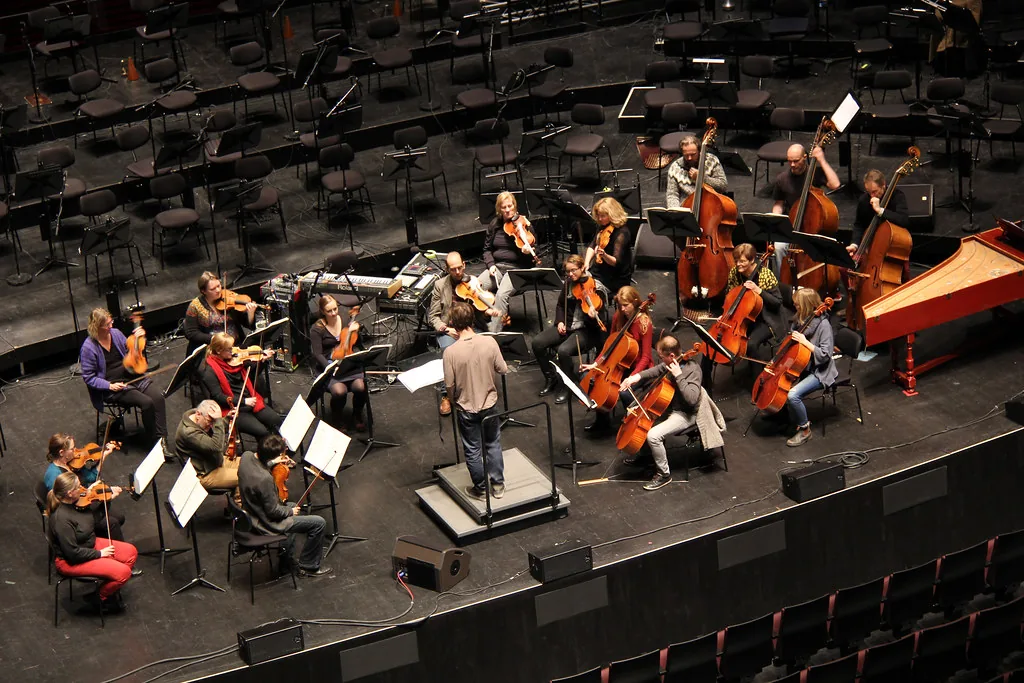
Claude Debussy left his mark on music history with his symphonic triptych, a masterpiece of Impressionism. Composed of three distinct movements, this work rewards attentive listening that reveals its full richness.
Historic interpretations, such as those by Georg Solti or the Concerts Lamoureux, offer an opportunity to rediscover the piece from a unique perspective. Each orchestra brings its own distinctive touch, revealing subtle nuances among Nuages, Fêtes and Sirènes.
The final movement, Sirènes, stands out for its inclusion of a women’s chorus, which presents ensembles with a technical challenge. To appreciate this work fully, it is essential to listen to it in its entirety, as available on platforms such as Radio France.
Finally, to better understand the thematic variations, it is helpful to listen for recurring motifs and the transitions between movements. Careful listening reveals all the magic of this timeless composition.
Introduction to Debussy’s Nocturnes
Between 1897 and 1899, Debussy composed a symphonic triptych that marked a key stage in his musical career. This work, originally intended for violin, evolved into a complex orchestral form.
Its three-part structure reflects distinct atmospheres: Nuages, Fêtes and Sirènes. Each movement explores different themes, creating a rich and immersive musical experience.
Compared with Pelléas et Mélisande, this composition demonstrates a remarkable artistic effort. The final movement, Sirènes, is distinguished by its use of 16 female singers, a technical challenge for ensembles.
In his correspondence, Debussy describes each movement precisely, revealing his artistic vision. The Concerts Lamoureux played a key role in the initial dissemination of this work.
Analyzed as a turning point between Romanticism and modernity, this triptych embodies the evolution of music at the dawn of the 20th century. It remains a touchstone for composers and music lovers.
Historical Context of the Nocturnes
Debussy’s Nocturnes originated in an artistic inspiration that blended music and painting. The influence of James Whistler, the American painter, is undeniable. His paintings, exhibited in Paris, captivated Debussy with their subtle treatment of light and mist.

Debussy maintained close ties with Stéphane Mallarmé, a central figure in the Symbolist movement. These artistic exchanges nourished his vision, although he expressed some irritation at persistent comparisons between his music and painting.
The musical translation of visual effects is a key aspect of the Nocturnes. Debussy transformed Whistler’s pictorial glazes into orchestral clusters, creating a unique atmosphere. This technique recalls the exhibition “Nocturne in Blue and Gold,” a major visual reference for the composer.
The work was later recognized as a bridge between Romanticism and modernity. It also received considerable publicity through the Concerts Lamoureux, which helped broaden its reach and popularity.
Musical Analysis of the Nocturnes
An analysis of the Nocturnes reveals unique musical richness shaped by technical and expressive innovations. Each movement explores distinct themes, creating an immersive and poetic experience.
Nuages: the immutability of the sky
The first movement, Nuages, is characterized by its A-B-A’ structure. Debussy uses pentatonic modes to evoke a calm, contemplative atmosphere. Parallel fifths in the strings, heard from the opening measures, create a distinctive atonal effect.
The polymodal treatment in section B adds a complex dimension, while the English horn introduces Wagnerian symbolism reminiscent of Tristan. This section embodies the immutability of the sky, a central theme of the movement.
Fêtes: movement and dance
Fêtes contrasts sharply with Nuages through its energetic rhythm and asymmetrical tarantella. Measures 28 to 39 illustrate a lively dance marked by tempo changes and varied textures.
This movement embodies excitement and motion, with repetitive motifs that evoke a nighttime celebration. Debussy plays with dynamics to create a sense of vitality and spontaneity.
Sirènes: the sea and its mysterious song
The final movement, Sirènes, is distinguished by the inclusion of a wordless women’s chorus. The chorus acts as an additional instrument, adding a mysterious and captivating dimension.
The wave motif (B–A-sharp) is developed as a cyclical ostinato, evoking the ceaseless motion of the sea. This section embodies the mysterious, hypnotic allure of the sirens and brings the work to a close in a dreamlike atmosphere.
To deepen your understanding of these techniques, read this detailed analysis.
Historic Interpretations of the Nocturnes
The first performances of the Nocturnes marked a turning point in the history of symphonic music. These concerts revealed the work’s complexity and beauty while highlighting the technical challenges it presented.

The Concerts Lamoureux
On December 9, 1900, a partial premiere took place under the direction of Camille Chevillard. This performance was followed by the first complete presentation on October 27, 1901, with 16 female singers recruited especially for Sirènes. This particularly demanding movement required 25 dedicated rehearsals to master its nuances.
The Société des Nouveaux Concerts played a key role in promoting this work. In 1921, a comparison of Chevillard’s and Toscanini’s tempos revealed contrasting interpretations, each offering a unique perspective.
“The historic 1959 recording with the Orchestre National RTF remains a touchstone for music lovers.”
| Date | Event | Details |
|---|---|---|
| December 9, 1900 | Partial premiere | Conductor: Camille Chevillard |
| October 27, 1901 | First complete performance | 16 female singers for Sirènes |
| 1921 | Comparison of tempos | Chevillard versus Toscanini |
| 1959 | Historic recording | Orchestre National RTF |
To learn more about these interpretations, read this detailed analysis.
Listen to Debussy’s Nocturnes in Full
Interpretations of Debussy’s Nocturnes offer a fascinating diversity, revealing nuances unique to each orchestra. These symphonic works, marked by their complexity, continue to inspire conductors and ensembles around the world.

Notable interpretations
Georg Solti’s version, recorded in 1959, is often cited for its handling of extreme dynamics. Solti captures the full subtlety of the contrasts, offering an immersive listening experience. More recently, the 2018 video recording by the Orchestre de Paris under Daniel Harding was praised for its modernity and precision.
Comparisons between the versions by Charles Munch (1956) and Pierre Boulez (1995) reveal distinct approaches. Munch favors a lyrical interpretation, while Boulez emphasizes structural clarity. These differences illustrate the richness of the work.
For those wishing to discover these interpretations, Radio France offers streaming recordings on France Musique. These resources enable an in-depth exploration of the nuances of each movement.
Finally, the inclusion of the Nocturnes in playlists such as “Classical Relaxation” attests to their universal appeal. With a total duration of 1 hour 33 minutes, this work remains a touchstone for lovers of symphonic music. To learn more about the earliest interpretations, read this detailed analysis.
Conclusion
Claude Debussy’s harmonic innovations in this symphonic triptych mark a turning point in music history. Each movement, with its distinct atmosphere, offers a unique experience. These compositions continue to inspire, particularly in cinema, as in the cult episode of Hitchcock’s “Vertigo.”
To continue your exploration, discover other major works such as La Mer or the Préludes for piano. In 2024, numerous symphonic programs paid tribute to this masterpiece, offering an ideal opportunity to rediscover it.
Attentive listening reveals the cyclical motifs that unite the three sections. For enthusiasts, the original manuscripts held by the BnF offer a fascinating glimpse into the creative process. Finally, Radio France offers enriching resources to deepen your understanding of this timeless work.