
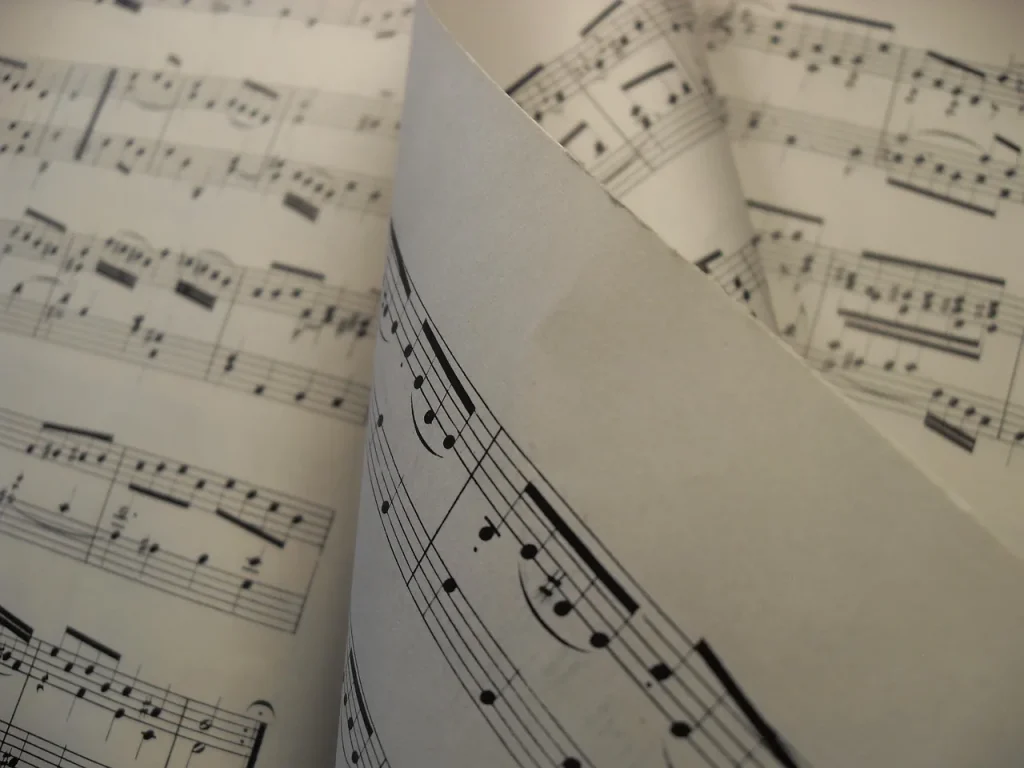
Claude Debussy, one of the greatest French composers, left his mark on the history of music through his unique approach. His work reveals a harmonious fusion of art and music, creating a fascinating dialogue between these two disciplines.
In 1911, Debussy declared: “I love pictures almost as much as music.” This philosophy is reflected in his works, in which pictorial inspiration plays a central role. For example, La Mer was directly inspired by Hokusai’s The Great Wave off Kanagawa.
The exhibition “Debussy, Music and the Arts” (Orangerie/Orsay, 2012) highlighted this close relationship. It also revealed the support provided by three upper-middle-class families—Lerolle, Chausson and Fontaine—for his artistic collaborations.
In Debussy’s work, visual inspiration coexists with the primacy of musical language. This duality enriches his creations and offers a unique sensory experience. To learn more about this fascinating connection, discover how the sea influenced art and music.
Claude Debussy’s Visual Inspirations
Claude Debussy’s creations are enriched by a constant dialogue with the art world. His works display a harmonious fusion of music and images, in which every note seems to evoke a painting. This unique symbiosis defined his era and continues to inspire today’s artists.
The Influence of Painters on His Works
Debussy drew inspiration from paintings by the great masters. For example, Printemps (1887) was inspired by Botticelli’s frescoes, while En blanc et noir pays tribute to Velázquez. L’Isle joyeuse, meanwhile, evokes Watteau’s poetic universe.
Artistic Collaborations and Their Impact
The collaboration with Maurice Denis on La Damoiselle élue illustrates this close relationship between music and art. Denis’s rare and precious Symbolist lithograph accompanies the score and creates a multisensory experience. This fusion marked a turning point in the art of the period.
The Role of the Parisian Bourgeoisie in His Career
The artistic salons of the Parisian bourgeoisie played a crucial role in Debussy’s career. Patrons such as Henry Lerolle, Ernest Chausson and Arthur Fontaine supported his projects. These encounters also enabled fruitful exchanges with figures such as Redon, Vuillard and Camille Claudel.
The score of the Nocturnes (1899), dedicated to Whistler, is a concrete example. This work embodies the harmony between music and images, a legacy that endures to this day.
Debussy and the Impressionist Movement
Debussy’s work resonates with a unique artistic sensibility. His style, often described as Impressionist, forms part of a broader artistic movement. This term, initially applied to painting, was later used to describe his music, creating a bridge between the two disciplines.

The Term “Impressionist” Applied to His Music
In 1887, a report by the Académie des Beaux-Arts criticized his “vague Impressionism.” Debussy replied:
“I am trying to do something else […] a term used as inappropriately as possible.”
This reaction demonstrates his disagreement with the label imposed on him while emphasizing his desire to innovate.
The Connections Between Music and Impressionist Painting
The comparison between Debussy and Monet is often made. While Monet plays with light, Debussy explores modal harmonies. La Mer (1905) is thus regarded as the musical equivalent of the Water Lilies. This symbiosis between art and music marks a crucial point in the history of creativity.
Criticism and Debate Surrounding His Style
The debates surrounding his style reflect the artistic tensions of the period. The contrast between Debussy and Berlioz illustrates these differences. While Berlioz favors a narrative approach, Debussy draws inspiration from Symbolist aesthetics. To explore this idea further, discover how Monet and Debussy converge in their artistic pursuits.
Musical Techniques and Visual Expression
Debussy’s music transcends the boundaries between art and sound. His innovative techniques reveal a profound connection between images and harmonies. This unique approach defined his era and continues to inspire today’s artists.
The Use of Musical Color
Debussy developed a rich palette of sound, often compared to painting. For example, in Les sons et les parfums tournent dans l’air du soir, he explores synesthesia, blending sounds and colors. This bold expression opened up new possibilities in the world of music.
Works Inspired by Nature
Nature occupies a central place in his work. Jardins sous la pluie evokes raindrops with remarkable precision. Debussy declared in 1908:
“Music is everywhere […] in the woods, the rivers and the air.”
This philosophy is reflected in his compositions, in which every note seems to paint a landscape.
The Fusion of Music and Literature
Debussy also drew inspiration from literature. His collaborations with writers gave rise to works such as La Damoiselle élue, in which music and poetry blend harmoniously. This fusion enriches his musical language and creates a multisensory experience.
| Work | Inspiration | Technique |
|---|---|---|
| La Mer | Japanese prints | Pentatonic scale |
| Jardins sous la pluie | Nature | Synesthesia |
| Les sons et les parfums | Literature | Musical color |
To explore this idea further, discover how Debussy influenced music.
Conclusion: Debussy’s Visual Legacy in Modern Music
Debussy’s legacy continues to resonate in contemporary music. His unique approach, characterized by the fusion of art and sound, continues to inspire today’s composers. From Miyazaki’s films to multimedia installations, his works transcend their era.
According to Michel Draguet, “Debussy, a bridge between the nineteenth century and modernity.” This quotation summarizes his key role in artistic development. Interdisciplinary collaborations, such as the concert held at the Bal Blomet on June 8, 2023, attest to this lasting influence.
To discover his universe, listen to the Tsybakov/Hervé recording. This immersive experience reveals the full richness of his musical expression. Debussy remains an essential figure whose influence extends into contemporary digital art.