
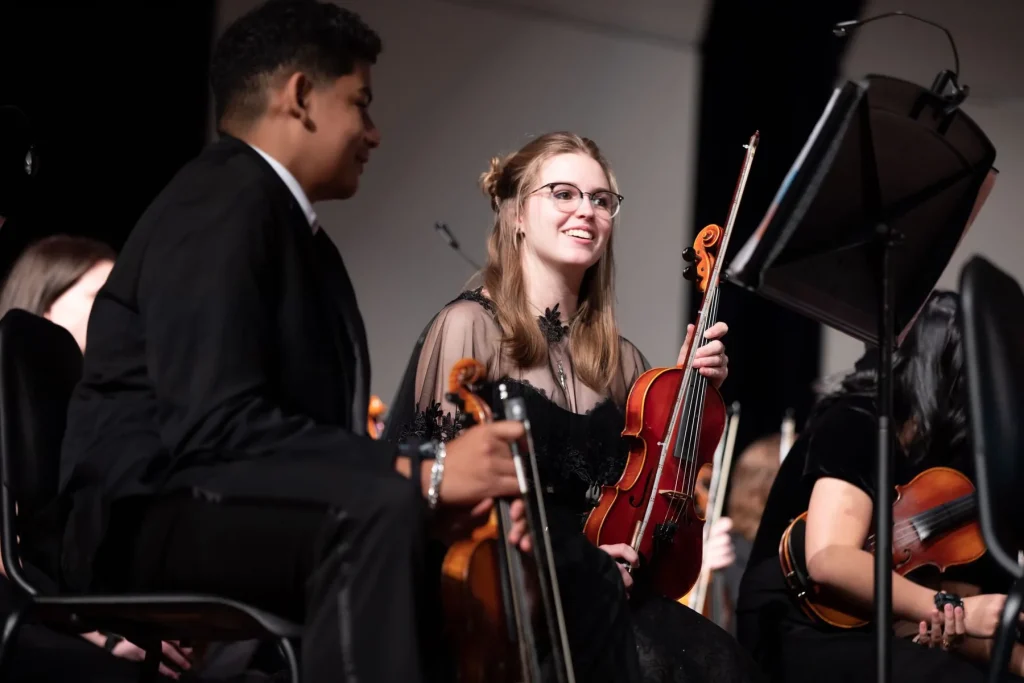
Serenade No. 13 in G major, known as “Eine kleine Nachtmusik,” is an essential masterpiece. Composed by Wolfgang Amadeus Mozart in 1787, it has become one of the most iconic pieces of classical music. Although rarely performed during Mozart’s lifetime, this work has crossed the centuries with undeniable popularity.
In this article, we will explore why this work is so highly regarded. How did a twenty-minute serenade written for a string quintet manage to win listeners’ hearts? We will delve into the historical context of Vienna in the late eighteenth century while examining the composer’s personal circumstances.
We will also analyze the four-movement structure of this joyful music. The mystery of the missing minuet and the work’s cultural impact will also be central to our discussion. Prepare to discover the fascinating world of a serenade that continues to delight music lovers around the globe.
Understanding search intent around “Eine kleine Nachtmusik: Why This Mozart Work Is So Famous”
The search for information about this famous serenade reveals a deep interest in its history and impact. English-speaking readers in particular want to explore the reasons behind its universal fame and its place in the classical repertoire. This search goes beyond simply listening to the music and extends to a richer understanding of its context.
Readers expect an exploration of the historical context of Vienna in 1787. This was a crucial year for Mozart, marked by the composition of Don Giovanni and the death of his father, Leopold. This historical setting sheds essential light on the creation of this iconic work.
Classical music enthusiasts also seek an accessible analysis of the serenade’s four movements. They want to understand the distinctive features of its writing for string quintet, as well as the mystery surrounding the lost movement. The work’s ability to capture the essence of Mozart’s genius, with its apparent simplicity and compositional mastery, is fascinating.
Moreover, the cultural impact of this music is significant. How has it been incorporated into films, advertisements, and video games? Contemporary artists such as Claude Bolling and Tenacious D have also been influenced by the work. This cultural dimension further enriches the listening experience.
The variety of interpretations, ranging from historically informed versions on period instruments to modern recordings, shows how the work has evolved over the decades. Music students and teachers often use this serenade to illustrate concepts such as sonata form and minuet-and-trio structure. This educational approach highlights the piece’s importance in music education.
In short, interest in this iconic work is driven by curiosity about its history, musical analysis, and influence. This demonstrates the serenade’s enduring importance in the history of classical music.
Historical context and origins of “Eine kleine Nachtmusik”
The creation of this famous serenade took place within a rich and dynamic musical setting. In 1787, Vienna was the beating heart of European classical music. The greatest composers of the era gathered there, and Wolfgang Amadeus Mozart, aged 31, was establishing himself as an independent composer. After breaking with the Prince-Archbishop of Salzburg, he successfully made a name for himself in this musical capital.
The Classical period was marked by a quest for balance and melodic elegance. Mozart’s works, including this serenade in G major, perfectly reflect that aesthetic. The composition of Eine kleine Nachtmusik appears to have been a joyful response to the intensity of his work on Don Giovanni, which premiered in Prague in October 1787.
The Classical period in Vienna in 1787
- In 1787, Vienna was the nerve center of classical music, where Mozart shone as an independent composer.
- The Classical period reached its height, emphasizing the balance and clarity characteristic of this serenade.
- While composing Don Giovanni, Eine kleine Nachtmusik emerged as a bubble of lightness.
Mozart’s personal circumstances during the composition
That year, a tragic event marked Mozart’s life: the death of his father, Leopold, a key figure in his musical education. This loss profoundly influenced his work. Joyful and lively, Eine kleine Nachtmusik could be seen as a way of coping with his grief, as musicologist Brigitte Massin suggested.
The exact circumstances of the commission remain unclear. Was it intended for a particular event, as light entertainment after the K. 515 and K. 516 quintets, or simply the result of a creative impulse? Most of Mozart’s serenades were written for festive occasions, but historians believe this work had no clearly defined purpose.
The autograph manuscript, rediscovered in 1943, reveals that the composition was completed on August 10, 1787. Mozart’s rapid handwriting reflects the urgency of his inspiration, a characteristic that marked his style throughout his career.
Wolfgang Amadeus Mozart: The composer and his era
Wolfgang Amadeus Mozart is often regarded as one of the greatest composers in the history of music. Born in Salzburg in 1756, he displayed exceptional musical gifts from a very early age. At three, he was already playing the keyboard, and at four, he composed his first minuet. At the age of eleven, he wrote his first opera, Apollo et Hyacinthus.
In 1787, when he composed the famous serenade, Mozart was 31 years old and at the height of his career. He had lived in Vienna for six years and had freed himself from the constraints imposed by the Prince-Archbishop of Salzburg. This change allowed him to explore his creative genius to the fullest.
A brief biography centered on 1787
- Wolfgang Amadeus Mozart embodied consummate musical genius and showed remarkable precocity.
- By 1787, he was an established composer who had already produced major works such as The Marriage of Figaro.
- He married Constanze Weber in 1782, strengthening his personal and professional life.
- The Köchel catalogue, which lists his works, contains more than 600 compositions.
- This period was marked by artistic emancipation, allowing him to fulfill commissions from Emperor Joseph II.
His musical influence and other major works
Mozart’s contributions to music are immeasurable. He raised sonata form, the concerto, and opera to unparalleled heights. Works such as Don Giovanni and Symphony No. 41 “Jupiter” illustrate his ability to unite complexity with accessibility.
Mozart’s Viennese period allowed him to express his talent freely. He also joined a Masonic lodge in Vienna, which influenced his music and thought. His premature death in 1791, at just 35 years old, preserved his work in eternal youth and helped forge the myth of the misunderstood genius.
| Year | Major event | Notable works |
|---|---|---|
| 1756 | Born in Salzburg | — |
| 1760 | First concerts | — |
| 1781 | Dismissed by the Prince-Archbishop | — |
| 1786 | Premiere of The Marriage of Figaro | — |
| 1787 | Composition of Don Giovanni and the serenade | — |
| 1788 | Composition of Symphony No. 41 “Jupiter” | — |
| 1791 | Death in Vienna | — |
Description and distinctive features of the composition
Serenade No. 13 in G major, entitled “Eine kleine Nachtmusik,” is a fascinating composition distinguished by its unusual ensemble. Written for string quintet, it calls for two violins, a viola, a cello, and a double bass. The latter merely doubles the cello at the octave, thereby creating four-part polyphony.
A unique string quintet and its instrumentation
The instrumental structure of this serenade is particularly remarkable. Unlike other Mozart serenades that require a full orchestra, this one is devoted entirely to strings. This gives it unmatched intimacy and purity of sound. Rather than playing an independent line, the double bass simply reinforces the bass part, demonstrating Mozart’s economy of means.
The composition date and first editions
The work was completed on August 10, 1787, as indicated by the autograph manuscript rediscovered in 1943. However, the score was not published until 1827, more than 35 years after the composer’s death. Mozart’s widow, Constanze, sold the work to the publisher Johann Anton André in 1799, contributing to its posthumous circulation.
The mystery surrounding the missing movement
A captivating mystery surrounds this composition. It originally had five movements, but the first minuet and trio was torn out and has never been found. In 1984, conductor Christopher Hogwood proposed a reconstruction, replacing the missing movement with a minuet and trio dating from 1785–1786 that had been created during composition lessons with Mozart’s pupil Thomas Attwood.
This serenade is often described as “little” because it lasts about twenty minutes, making it approachable and charming. Despite its brevity, it captures the essence of Mozart’s genius and continues to delight listeners around the world.
| Element | Details |
|---|---|
| Title | Serenade No. 13 in G major, “Eine kleine Nachtmusik” |
| Completion date | August 10, 1787 |
| Instrumentation | String quintet: 2 violins, 1 viola, 1 cello, 1 double bass |
| Original structure | Five movements (minuet and trio missing) |
| Publication | Sold in 1799, published in 1827 |
| Reconstruction | Minuet and trio by Hogwood in 1984 |
| Duration | Approximately 20 minutes |
Structure and detailed analysis of the four movements
An analysis of the four movements of this iconic work reveals fascinating musical richness. Each contributes a unique color, illustrating Mozart’s mastery of composition.
First movement: Energetic Allegro
The first movement, an Allegro in G major in 4/4 time, is undoubtedly one of the most recognizable passages in the entire history of classical music. Its energetic ascending theme captures the very essence of Mozartian joy.
This movement follows classical sonata form, with an exposition, development, and recapitulation. It spans 137 measures divided into two large repeated sections, creating a perfect balance between familiarity and surprise.
Second movement: Dreamy and agitated Romance
The second movement, a Romance in C major marked Andante, provides a striking contrast. Its dreamy melody evokes a nighttime serenade before shifting into an agitated central section in C minor, introducing unexpected dramatic tension.
The structure of this Romance is elaborate, with several repeated sections and a soothing coda. The coda returns the listener to the serenity of the opening, demonstrating Mozart’s mastery of emotional variation.
Third movement: Minuet and trio with subtle contrasts
The third movement is a Minuet and Trio marked Allegretto in G major, with a central trio in D major. It follows the tradition of the court dance while imbuing it with subtle contrasts and rhythmic elegance.
With 16 measures in its first section and 20 in the trio, this minuet illustrates Mozart’s ability to renew a conventional galant form by introducing harmonic refinements and unexpected dynamic interplay.
Fourth movement: Dynamic final rondo
The fourth and final movement is a Rondo Allegro in G major. This form is characterized by the periodic return of a lively refrain between contrasting episodes. It concludes the serenade with an explosion of vitality and infectious good humor.
This dynamic finale, 163 measures long and furnished with a brilliant coda, uses 2/2 time to create a sense of joyful urgency. Together, the four movements form a remarkably coherent musical architecture in which every part finds its place within the overall balance.
Famous interpretations and historical discography
The richness of this piece emerges through the many interpretations that have brought it to life. Since its creation, the serenade has inspired a great number of recordings, demonstrating its enduring appeal. Interpretations range from chamber versions to orchestral performances, each bringing its own color to the work.
Original chamber versions and orchestral versions
The very first recording of the serenade dates from 1928 and was conducted by John Barbirolli. It was a landmark moment, launching a recording tradition that would make the piece one of the most frequently recorded works in the classical repertoire.
During the twentieth century, performances chiefly favored large symphony orchestras. Benchmark versions, such as the recording by the Vienna Philharmonic conducted by Karl Böhm, offered a broad and Romantic reading of the score.
From the 1970s onward, a trend emerged in favor of performances on period instruments, restoring the work’s original chamber character. Ensembles such as the Talich Quartet and the Hagen Quartet respected the original string-quintet scoring, revealing compositional details often obscured by large orchestras.
Landmark recordings of the twentieth and twenty-first centuries
In the 1990s, Baroque orchestras such as The English Concert, conducted by Andrew Manze, and Nikolaus Harnoncourt’s Concentus Musicus Wien brought a new stylistic understanding to the work. These interpretations are characterized by livelier tempos and close attention to Mozart’s markings.
One historic milestone is the recording by Christopher Hogwood and The Academy of Ancient Music, released by L’Oiseau-Lyre in 1984. It presents a reconstruction in which the missing minuet is replaced by a piece composed by Mozart and his pupil Thomas Attwood.
Modern interpretations move between historical authenticity and personal expressiveness. Each version demonstrates the inexhaustible richness of a score that lends itself to a wide variety of approaches.
The work’s discography is so extensive that it provides a panorama of the evolution of musical performance over the past century, from the first 78 rpm records to high-definition digital recordings.
| Year | Performance | Conductor |
|---|---|---|
| 1928 | First recording | John Barbirolli |
| 1960 | Vienna Philharmonic | Karl Böhm |
| 1984 | Reconstruction with missing minuet | Christopher Hogwood |
| 1990 | The English Concert | Andrew Manze |
| 1991 | Concentus Musicus Wien | Nikolaus Harnoncourt |
Cultural impact and resonance through the centuries
The fame of the serenade extends far beyond classical music. Indeed, this little piece of music has established itself in many cultural fields, particularly film, television, and video games. Its timeless charm and recognizable melody make it a popular work that resonates across generations.
Use in film, television, and video games
In cinema, Eine kleine Nachtmusik has appeared in iconic films. For example, in Miloš Forman’s Amadeus, it is played by the character Antonio Salieri, creating a moment of dramatic irony. The film highlights Mozart’s genius through the eyes of his rival.
Likewise, films such as Tim Burton’s Batman and Luc Besson’s Nikita use the melody to add elegance to their soundtracks. In French cinema, it appears in Valérie Lemercier’s Palais royal!, where it is arranged for accordion, and in Les Profs 2, demonstrating its ability to adapt to different styles.
The serenade has also found its way into video games. It appeared in Nintendo’s classic Mario Bros. as early as 1983, followed by other titles such as Donkey Konga 3 and Wii Music. These games introduce generations of players to classical music, contributing to its popularity.
Adaptations and covers in popular music
Adaptations of this night music demonstrate how permeable the boundaries between genres can be. Jazz pianist Claude Bolling recorded a swing version in 1965 for his album Jazzgang Amadeus Mozart. The satirical hard-rock band Tenacious D drew inspiration from it for the song Classico, proving that the work continues to influence contemporary creativity.
In 2015, the French duo Alain Souchon and Laurent Voulzy used the melody of the fourth movement as the basis for their song Oiseau malin. This modern use shows how Mozart’s melodic genius endures in contemporary culture.
Finally, since 1952, the opening of the fourth movement has served as the theme music for the British radio quiz Brain of Britain, making the melody one of the most frequently broadcast on the BBC airwaves.
This omnipresence in popular culture has made the work one of the most accessible gateways to classical music. It thus acts as a cultural bridge between eras and generations, allowing everyone to discover the magic of Mozart’s music.
Eine kleine Nachtmusik: Why this Mozart work is so famous
This iconic musical work has won the hearts of music lovers through the ages. The universal fame of Eine kleine Nachtmusik rests first of all on its timeless charm and infectious joy. This rare quality allows every listener, regardless of age, culture, or musical knowledge, to be immediately touched by the beauty of its melodies.
The striking contrast between the dark circumstances of its composition—Mozart had just lost his father, Leopold—and the score’s radiant brightness creates a mystery that has fascinated music lovers and historians for generations. According to musicologist Brigitte Massin’s analysis, the serenade could be interpreted as a lighthearted response to the great K. 515 and K. 516 quintets. It reflects the composer’s way of laughing to keep from crying, in the manner of the dramma giocoso of Don Giovanni, composed in the same year.
The work’s immediate accessibility, owing to its relatively short duration of about twenty minutes and the clarity of its four-movement structure, makes it an ideal introduction to classical music for newcomers. The opening melody of the initial Allegro has become one of the most recognizable in all musical history, comparable to the opening notes of Beethoven’s Fifth Symphony, giving it the status of a universal cultural icon.
This serenade plays a fundamental educational role in spreading and explaining classical music. It provides exceptionally clear illustrations of musical forms such as sonata form, minuet and trio, and rondo. The work’s ability to cross the centuries without losing its freshness testifies to the genius of Wolfgang Amadeus Mozart, who captured an essence of pure joy and formal balance in these pages.
Finally, its constant presence in popular culture—from film and video games to advertising—has transformed Eine kleine Nachtmusik into a true piece of humanity’s shared musical heritage. It is known and loved far beyond the circle of classical music enthusiasts.
Conclusion
This iconic piece has captivated entire generations, illustrating the timeless genius of its composer. Eine kleine Nachtmusik transcends its status as a mere serenade to become a symbol of the immortality of musical creativity. Composed during a difficult period in Mozart’s personal life, the work has crossed more than two centuries without losing any of its freshness or brilliance.
The richness of its four-movement structure offers a perfect microcosm of Mozart’s art. Its countless interpretations, from chamber versions to grand orchestral readings, demonstrate the score’s flexibility. Moreover, its cultural influence, apparent in film and popular music, makes it part of humanity’s common heritage.
Ultimately, this serenade remains an eternal invitation to beauty, a link between the general public and classical music. It embodies music’s unique ability to touch the heart: a truly timeless masterpiece.