
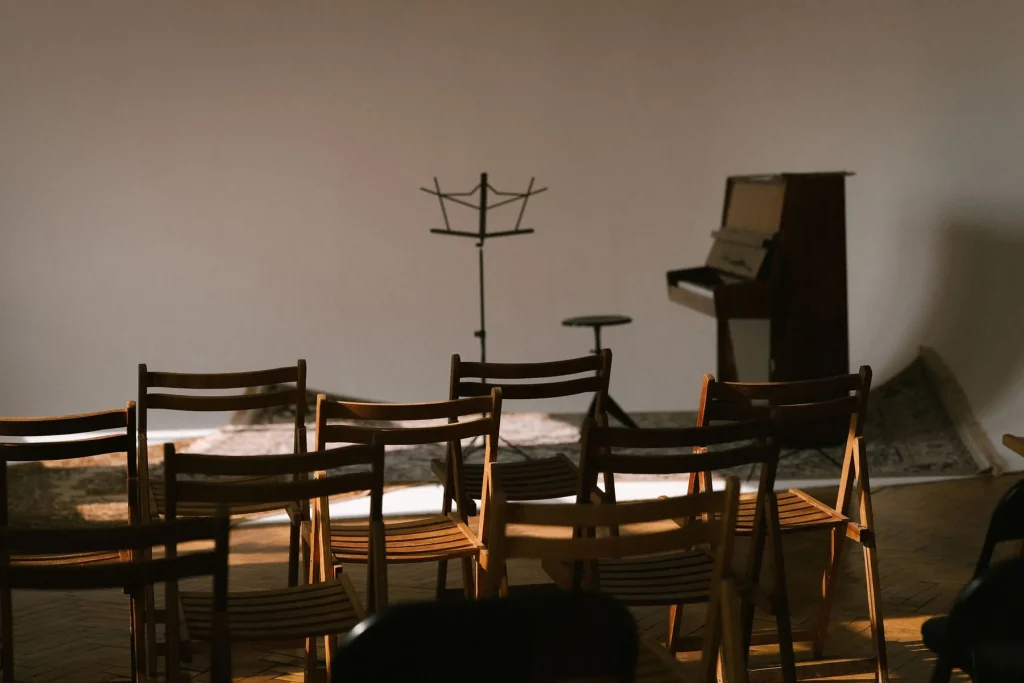
Claude Debussy, one of the greatest composers of classical music, made history with his Suite bergamasque. Originally composed in 1890 and published in 1905 after several revisions, this work reflects a major stylistic transition in his career.
Inspired by the folk dance of Bergamo and Verlaine’s poem “Clair de lune,” this piece embodies Debussy’s evolution from Romanticism to Impressionism. It played a foundational role in the emergence of this musical movement in France.
Structured in four movements, the Suite bergamasque offers a rich exploration of emotions and musical textures. It remains an essential work for understanding Debussy’s artistic impact.
History and origins of the Suite bergamasque
Created at the end of the nineteenth century, the work was subsequently extensively reworked. Originally composed in 1890, it underwent a major revision in September 1905. The composer sought to soften his initial post-Romantic style, thus marking a transition toward a more refined musical language.
The 1890 and 1905 versions display notable differences. The first was bolder, while the second reflects greater stylistic maturity. Whether these revisions were motivated by editorial demands or by Debussy’s personal artistic development remains a matter of debate.
The Bergamasque imagination, inspired by Italian folk dances, permeates this piece. The third movement, entitled Clair de lune, directly references Paul Verlaine’s poem. This correspondence between musicality and poetic symbolism gives the work unique depth.
The late publication of this Suite bergamasque influenced its critical reception. Although composed earlier, it gained widespread recognition only after its revision, subsequently becoming a cornerstone of musical Impressionism.
Musical analysis of the Suite bergamasque
Debussy’s Suite bergamasque reveals a fascinating musical complexity. Structured in four parts, the work offers an immersion in the artist’s sound world. Each movement creates a distinct atmosphere, reflecting a transition between Romanticism and Impressionism.

Structure and movements of the suite
The piece consists of a Prélude, a Menuet, Clair de lune, and a Passepied. The Prélude serves as an atmospheric opening, while the Menuet reinterprets a Baroque dance with a modern touch. The third movement, in D-flat major, is particularly renowned for its expressive andante tempo.
Harmonic ambiguity in “Clair de lune”
In Clair de lune, Debussy uses unresolved chords and bold modulations. This harmonic ambiguity creates the floating sensation characteristic of Impressionism. The piano is handled with unparalleled delicacy, producing a rich and evocative musical texture.
The evolution of Debussy’s style
This work marks a key stage in the evolution of Debussy’s style. It reveals a transition between Romantic virtuosity and Impressionist suggestiveness. Compared with his later works, such as Estampes, it demonstrates an early exploration of modes and innovative harmonies.
Notable interpretations and recordings
Recordings of the Suite bergamasque reflect unique artistic approaches. Each pianist brings a personal vision, offering a diversity of interpretations that enriches the work.
Landmark versions of the Suite bergamasque
Among the most celebrated recordings, that of Samson François (Erato, 1968) stands out for its controlled eccentricity. His bold rubato and contrasting dynamics captivate the listener. In 2008, Jean-Efflam Bavouzet (Chandos) offered a version characterized by clear articulation and poetic fluidity.
Other performers, such as Coppola, have achieved a balance between rigor and sensitivity, particularly in the third movement. Some versions, however, such as Arrau’s, have been criticized for their excessive slowness.
Jean-Efflam Bavouzet’s interpretation
Bavouzet brings a modern touch to this classical work. His approach emphasizes technical precision while retaining profound emotion. His version is often cited as a benchmark for young pianists.
Samson François’s unique vision
François, for his part, explores the nuances of the score with remarkable artistic freedom. His interpretation, recorded in under 60 minutes, is a model of spontaneity and creativity. It remains a source of inspiration for classical-music enthusiasts.
Despite their differences, these recordings attest to the richness of the Suite bergamasque. They show how the same work can be reinvented across eras and styles.
Conclusion: the legacy of the Suite bergamasque
Claude Debussy’s Suite bergamasque remains an essential piece in the world of classical music. Its third movement, Clair de lune, has transcended the ages and appears in more than 120 films and advertisements. The work continues to inspire modern composers such as John Williams and remains a cornerstone of intermediate piano instruction.
Its influence extends beyond the concert hall. Jazz and electronic reinterpretations of this piece attest to its contemporary resonance. It also embodies a major artistic transition between the nineteenth and twentieth centuries, marking a key stage in the evolution of musical language.
Future prospects include orchestration projects and cross-disciplinary artistic collaborations, proving that Debussy’s legacy remains alive. To learn more about the masterpieces of French classical music, consult this resource.