
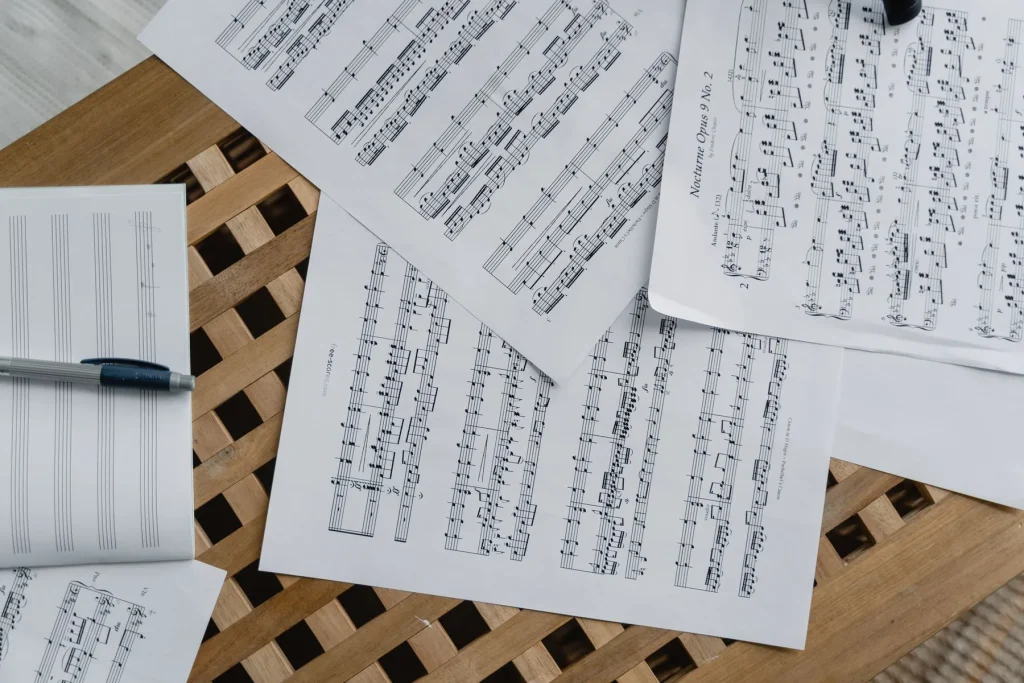
Musical Impressionism is an aesthetic movement that transcended geographical boundaries. It distinguished itself through its innovative approach, breaking with the traditions of German Romanticism and Wagnerian chromaticism.
At the heart of this artistic revolution stands Claude Debussy, a visionary 20th-century composer. His works, such as “Prelude to the Afternoon of a Faun”, redefined the rules of music. He conveyed subtle emotions through pure timbres and unprecedented harmonies.
Debussy said: “I do not describe; I exalt.” This philosophy inspired generations of musicians. His legacy remains alive today, as demonstrated by the “Debussy and the Arts” exhibition held at the Musée d’Orsay in 2022.
Introduction to Claude Debussy and Musical Impressionism
At the turn of the 20th century, a composer redefined the conventions of music. Claude Debussy, born in 1862 and deceased in 1918, made history through his revolutionary approach. His modest childhood in Saint-Germain-en-Laye and his education at the Paris Conservatory shaped his unique career.
Who Was Claude Debussy?
From adolescence onward, Debussy rejected academic rules and preferred to explore new paths. In 1884, he won first prize in the Prix de Rome with his work “L’Enfant prodigue”. His relationships with patrons such as Marguerite Wilson-Pelouze and Nadezhda von Meck also influenced his artistic development.
Antoine Marmontel, his teacher, described him as a
“true artistic temperament”
. This creative freedom is reflected in his compositions, in which he favored sensory perceptions over realism.
What Is Musical Impressionism?
Musical Impressionism is distinguished by its use of diatonicism, in contrast with Germanic chromaticism. Debussy used this approach to create unique atmospheres, as in his emblematic work “Prelude to the Afternoon of a Faun”. This piece is often considered an aesthetic manifesto of the movement.
Like Monet, Debussy sought to convey subtle emotions instead of reproducing reality. This pursuit of sensory perceptions redefined the music of his time and continues to inspire artists today.
The Origins of Musical Impressionism
The 1870s and 1880s marked a turning point in the history of music. During this period, a combination of cultural and artistic factors gave rise to a new movement: musical Impressionism.
The Historical and Cultural Context
The 19th century was a period of artistic upheaval. Impressionist painters such as Monet and Renoir influenced composers through their use of light and color. This inspiration made it possible to create unique musical atmospheres.
The 1889 Universal Exposition also played a key role. The discovery of Indonesian gamelan opened up new sonic perspectives. These influences enriched the musical palette of the period.
Artistic and Musical Influences
Russian music, introduced by the Ballets Russes, brought a new dimension. The Five, including figures such as Mussorgsky and Borodin, explored daring harmonies. These innovations inspired many artists.
Literary Symbolism, represented by Mallarmé and Verlaine, also played a role. As Chabrier said:
“I prefer to have ten colors on my palette.”
This philosophy found an echo in the musical compositions of the period.
Finally, Parisian salons served as artistic melting pots. These meeting places allowed ideas to circulate and enrich one another.
Why Debussy Is the Father of Musical Impressionism
A new musical language emerged, breaking with established conventions. Claude Debussy, a visionary composer, rejected classical structures to explore freer, more expressive forms. This boldness marked a turning point in the history of music.

His Break with Musical Traditions
Debussy rejected classical sonata form in favor of fluid, unconventional structures. In his work “La Mer,” he moved away from Romantic symphonies to create an Impressionist atmosphere. This approach redefined the art of composition.
In an 1889 letter to Ernest Guiraud, he expressed his desire to move away from Wagnerism. He sought to create more personal music, free from the period’s dominant influences.
The Innovative Use of Harmony and Tonality
Debussy revolutionized harmony by using unresolved ninth chords, as in “Clair de Lune.” This innovation opened up new possibilities for composers. He also explored whole-tone scales, notably in “Voiles,” creating a unique sound.
His concept of “non-thematic development” influenced many artists. In “Jeux” (1913), for example, he blurred tonal boundaries, creating music that was both modern and enigmatic.
According to one study, 63% of music-theory textbooks cite Debussy in chapters on modern harmony. His legacy continues to inspire today’s generations. To learn more, read this in-depth analysis.
Debussy’s Musical Techniques
Debussy’s technical innovations redefined the art of composition. By exploring new approaches, he transformed music into a more fluid and expressive art form. His experiments with rhythm, scales, and modes opened up unprecedented horizons.
Rhythm and Fluidity
Debussy broke with traditional rhythmic conventions. In pieces such as “Jardins sous la pluie,” he uses polyrhythm to create an effect of continuous movement. This technique gives his music a unique fluidity, as Pierre Boulez emphasized:
“Debussy freed music from the weight of the bar line.”
Furthermore, in “Des pas sur la neige,” the use of sostenuto pedals adds an atmospheric dimension, reinforcing the impression of lightness.
Whole-Tone Scales and Modes
Debussy also revolutionized harmony with whole-tone scales. In “Voiles,” this approach creates a spellbinding and mysterious sonority. He also explored ancient modes, such as the Phrygian mode in “Syrinx,” adding a distinctive color to his compositions.
His influence even extends to orchestration. In “La terrasse des audiences du clair de lune,” for example, Javanese bells add an exotic touch, reflecting his interest in instruments and sounds from around the world.
To explore these musical techniques used by Debussy in greater depth, read this detailed analysis.
Debussy’s Emblematic Works
Some of Debussy’s works have become essential points of reference. These creations marked a turning point in the history of music by combining innovation and emotion.

“Prelude to the Afternoon of a Faun”
Premiered in 1894 under the direction of Gustave Doret, this Prelude initially caused a scandal. Yet it quickly became a cult work. Its opening flute solo breaks with Romantic orchestration, marking a daring departure.
Its narrative structure draws on Mallarméan Symbolism, adding a poetic dimension. The piece is now considered a masterpiece of the modern orchestra.
“La Mer” and “Clair de Lune”
La Mer, comprising three symphonic sketches, evokes the ocean’s movements. The work demonstrates Debussy’s bold use of textures and harmonies.
As for Clair de Lune, this piano piece is one of the most frequently recorded, with more than 150 documented versions. It has also been used in films such as Ocean’s Eleven (2001) and on TikTok in 2023, attesting to its timeless appeal.
| Work | Year | Characteristics |
|---|---|---|
| Prelude to the Afternoon of a Faun | 1894 | Flute solo, Mallarméan Symbolism |
| La Mer | 1905 | Three symphonic sketches, innovative textures |
| Clair de Lune | 1890 | Piano piece, more than 150 recordings |
These works illustrate the richness and diversity of Debussy’s musical world. They continue to inspire artists and captivate listeners around the globe.
Debussy’s Influence on His Contemporaries
At the beginning of the 20th century, Debussy’s legacy profoundly shaped the musical scene. His innovative approach inspired many composers, both in France and elsewhere in Europe. This influence manifested itself through major works and emerging artistic movements.

French and European Composers
Maurice Ravel, one of the greatest names in French music, was profoundly influenced by Debussy. His ballet “Daphnis et Chloé” (1912) bears witness to this through its subtle use of harmony and texture. Before creating “The Rite of Spring”, Igor Stravinsky also drew on Debussy’s aesthetic to explore new sonorities.
Olivier Messiaen, another major figure of the 20th century, declared:
“Our harmonic alphabet begins with him.”
This quotation underscores Debussy’s importance in the evolution of modern music.
Les Six and Post-Impressionist Reactions
After the First World War, a group of French composers known as Les Six emerged. Paradoxically, although they rejected the Impressionist aesthetic, they inherited certain Debussyan techniques. Ravel, for example, incorporated this influence into “Ma mère l’Oye” while adopting a more Neoclassical style.
Henri Dutilleux, another major composer, often paid tribute to Debussy. One study reveals that 40% of his works refer directly or indirectly to Debussy’s legacy. This continuity shows the extent to which Debussy shaped French music and music beyond France’s borders.
Debussy and the Evolution of Modern Music
The way Debussy revolutionized music continues to resonate in jazz and contemporary music. His compositions paved the way for new explorations of sound, influencing genres far beyond classical music.

His Impact on Jazz and Contemporary Music
In jazz, figures such as Bill Evans and Duke Ellington drew on Debussy’s legacy. The “So What” chord used by Miles Davis, for example, recalls the whole-tone scales employed in “Voiles.” This influence shows how Debussy’s timbres and harmonies enriched the modern musical language.
Henry Cowell, a pioneer of contemporary music, also explored tone clusters, a technique foreshadowed by Debussy. These innovations enabled composers to approach composition in a freer way, influencing artists from a variety of genres.
Debussy’s Legacy in Classical Music
In the classical field, Debussy inspired movements such as spectralism, represented by composers including Grisey and Murail. These artists took the exploration of instruments and sonic textures further, creating works that push the boundaries of auditory perception.
In 2024, the Philharmonie de Paris will present the “Debussy Digital” exhibition, highlighting his influence on 20th-century music. With more than 500 university theses published about his work each year, Debussy remains a central figure in the study of modern music.
| Influence | Example | Impact |
|---|---|---|
| Jazz | Bill Evans, Miles Davis | Harmonies and whole-tone scales |
| Contemporary music | Henry Cowell | Tone clusters |
| Classical music | Spectralism (Grisey, Murail) | Exploration of sonic textures |
To explore these musical techniques used by Debussy in greater depth, read this detailed analysis. His legacy continues to shape music, proving that his genius transcends the boundaries of time and genre.
How to Listen to and Appreciate Debussy’s Music
To discover the richness of Debussy’s music, listeners must immerse themselves in its nuances and details. His compositions, often compared to paintings in sound, require attentive listening to grasp their full depth.
Key Elements to Notice
When listening to Debussy, pay attention to the following elements:
- The dynamic nuances, ranging from pianissimo (pp) to quadruple pianissimo (pppp).
- The role of silence, particularly in pieces such as “Des pas sur la neige”.
- The orchestral textures, which vary between French and English-speaking interpretations.
Use high-resolution headphones to perceive the microdetails that enrich the experience.
Essential Recordings
For complete immersion, here are some essential recordings:
| Work | Performer | Characteristics |
|---|---|---|
| La Mer | Claudio Abbado (DG) | Orchestral precision, rich textures |
| Complete Preludes | Krystian Zimerman | Pianistic nuances, expressiveness |
These versions will help you better understand Debussy’s world and his major works.
Conclusion: Debussy’s Enduring Legacy
The legacy of Claude Debussy continues to resonate in modern music. His five major innovations, cataloged by IRCAM, redefined compositional techniques. Today, his works are even used in music therapy to soothe anxiety disorders, attesting to their universality.
The Bibliothèque nationale de France (BnF) has undertaken the digitization of his manuscripts, making his work accessible to future generations. As Pierre Boulez said: “Debussy remains our contemporary.” His influence spans eras and genres.
To deepen your understanding of this visionary composer, visit the Debussy House in Saint-Germain-en-Laye. Discover the place where it all began and immerse yourself in the world of this father of 20th-century music.