
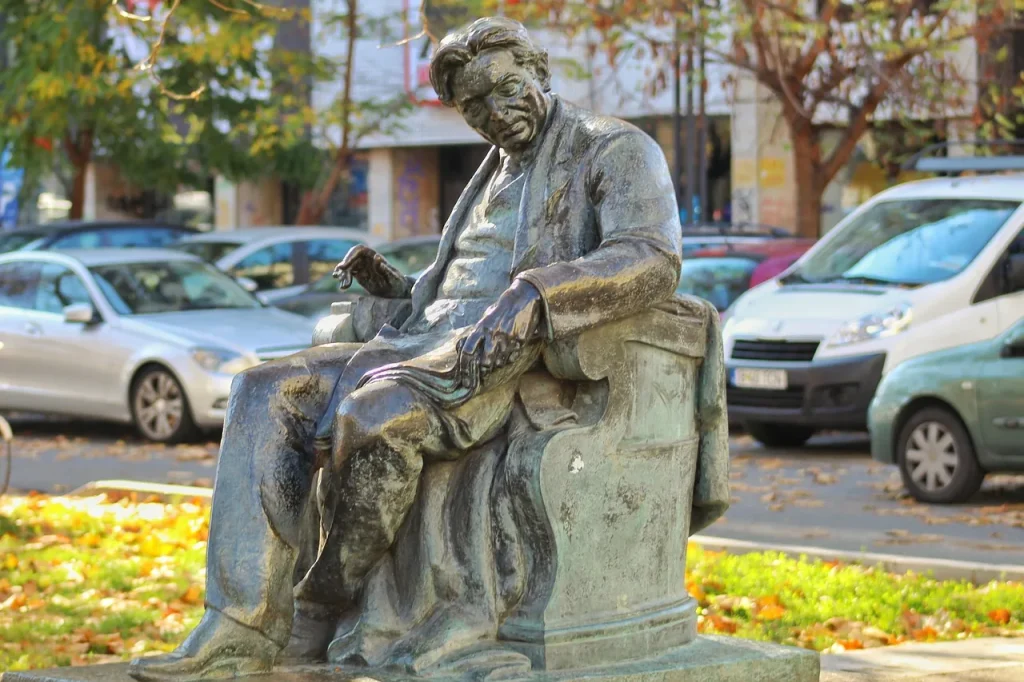
Claude Debussy, born in 1862 and deceased in 1918, is one of the most influential composers in the history of music. His work, marked by bold harmonic innovations, redefined the boundaries of musical creation.
At the turn of the 20th century, Debussy captured the spirit of his time while opening up new perspectives. His compositions, inspired by a variety of artistic influences, left an indelible mark on genres such as jazz and contemporary music.
With more than 130 works to his name, Debussy made his mark on his era through his creative genius. His legacy continues to inspire today’s artists, making him an essential figure in the history of music.
Introduction: Claude Debussy, a musical genius
August 22, 1862 marked the birth of a musical genius, Claude Debussy. Born in Saint-Germain-en-Laye, he grew up in a modest family beset by financial difficulties and a turbulent home life. His revolutionary father was imprisoned during the Paris Commune, leaving a profound mark on his childhood.
Despite these hardships, Debussy discovered his passion for the piano at an early age. At eight, he began taking lessons from his aunt Clémentine, who taught him the basics of the instrument. This early discovery became the starting point of his artistic development.
The contrast between his difficult childhood and his emerging talent is striking. While still a teenager, he composed his first works, revealing an extraordinary musical sensitivity. These modest beginnings already foreshadowed the immense contribution he would make to music.
With his innovative approach to the piano, Claude Debussy transformed the musical conventions of his time. His legacy, born from a complex childhood, continues to inspire future generations.
Claude Debussy’s early years: a modest childhood
In August 1862, a modest family in Saint-Germain-en-Laye welcomed a future musical genius. Claude Debussy’s parents, porcelain merchants by trade, lived amid financial difficulties and political upheaval.
During the tumultuous years of the Paris Commune in 1871, the family had to move to Cannes. This unstable period left a profound mark on young Claude, but did not hinder his artistic development.
Birth and family
Claude Debussy was born into a household in which craftsmanship played a central role. His father, Manuel-Achille, was a revolutionary imprisoned for his beliefs, while his mother, Victorine, oversaw the children’s education. Despite their difficulties, the family encouraged Claude’s emerging talents.
First encounters with music
At the age of eight, Claude Debussy discovered the piano through his aunt Clémentine. She taught him the basics of the instrument, awakening a passion that would never leave him. He later took violin lessons from Jean Cerutti and refined his piano playing with Antoinette Mauté, a pupil of Chopin.
These first musical experiences proved decisive. At only ten, Claude entered the Paris Conservatory, marking the beginning of his career as a musician. To learn more about this period, read this detailed biography.
Debussy’s musical education at the Paris Conservatory
Claude Debussy forged his unique style at the Paris Conservatory. This prestigious institution provided the setting for his education, during which he met influential teachers and developed unconventional methods.
Teachers and early influences
Antoine Marmontel, his piano teacher, quickly recognized his talent. He described Debussy as a
“truly artistic temperament”
. His relationship with Émile Durand, his harmony teacher, was more contentious, however. Debussy often challenged academic rules, preferring to explore innovative paths.
During his years at the Conservatory, he discovered the works of Wagner and Mussorgsky. These composers profoundly influenced his musical approach. In 1879, he composed his first vocal works to texts by Musset, marking the beginning of his creative career.
An unconventional student
Debussy stood out for his unconventional methods. He often circumvented the Conservatory’s strict rules, preferring to follow his intuition. This attitude earned him criticism, but also early recognition.
In 1877, he won second prize for piano, followed by first prize for accompaniment in 1880. These awards confirmed his talent and paved the way for a promising career.
| Year | Event |
|---|---|
| 1877 | Second prize for piano |
| 1880 | First prize for accompaniment |
The Prix de Rome and his stay at the Villa Medici
In 1884, Claude Debussy won the Prix de Rome, a major turning point in his career. This prestigious distinction gave him the opportunity to stay at the Villa Medici in Rome, a place conducive to artistic creation.

During his stay, he composed the cantata L’Enfant prodigue, a work that earned him praise from the Academy. Debussy nevertheless felt stifled by the rigid environment of the Villa Medici. In his correspondence, he expressed his unhappiness and desire for artistic freedom.
The cantata L’Enfant prodigue
The cantata L’Enfant prodigue marked a key moment in Debussy’s development. Inspired by the biblical text, the work reveals his mastery of composition and his talent for expressing emotion. It enabled him to gain recognition from his peers despite his tensions with the Academy.
Italy’s influence on his style
His stay in Italy profoundly influenced Debussy. He drew inspiration from the landscapes and local culture to compose Printemps in 1887. Marked by innovative harmonies, this work heralded his personal style, freed from academic constraints.
The Prix de Rome and his stay at the Villa Medici thus played a crucial role in Debussy’s artistic development, paving the way for his future innovations.
Portrait of the composer Debussy: life and influences
In the 1890s, Claude Debussy immersed himself in the world of Symbolist salons. These artistic circles, where poets, painters and musicians mingled, became a major source of inspiration for him. There he met figures such as Paul Dukas and Pierre Louÿs, who would profoundly influence his work.
His discovery of the works of Edgar Allan Poe and Maurice Maeterlinck in 1890 marked a turning point. These authors fed his imagination, and their influence is reflected in his compositions. Debussy also drew inspiration from Symbolist poets such as Mallarmé and Baudelaire to create music rich in emotion and symbolism.
Fascinated by Japanese prints, Debussy incorporated visual elements into his art. This influence can be heard in his compositions, in which he sought to transcend the limits of traditional music. He developed the concept of “invisible music,” an approach that gives priority to atmosphere and emotion.
Paris played a central role in his inspiration. With its salons and encounters, the city became the crucible of his creative genius. His friendships with Erik Satie, Gabriel Fauré and Igor Stravinsky enriched his musical world and made him a multifaceted musician.
Claude Debussy’s major works
Claude Debussy’s works redefined the boundaries of modern music. Among his creations, three pieces stand out for their boldness and lasting influence.
Prélude à l’après-midi d’un faune
Composed in 1894, the Prélude à l’après-midi d’un faune marked a harmonic revolution. The use of a solo flute at the opening creates a dreamlike atmosphere reflecting Mallarmé’s poem. Initially controversial, this work is now considered a masterpiece of the modern orchestra.
In it, Debussy explored unprecedented sonorities, breaking with the conventions of his time. The Prélude ushered in a new musical era and influenced genres such as jazz and contemporary music.
Pelléas et Mélisande
In 1902, Debussy presented his only opera, Pelléas et Mélisande. Inspired by Maeterlinck’s play, the opera is distinguished by its speech-like singing. This lyrical innovation creates a unique intimacy between the characters and the audience.
Often described as a musical poem, the work explores universal themes such as love and jealousy. It remains a landmark in the history of opera and marked a turning point in operatic creation.
La Mer
Composed between 1903 and 1905 in Bichain, La Mer is an Impressionist symphony. Debussy captures the nuances of the ocean through shifts in timbre that evoke waves and storms. This three-movement work pays tribute to the power and beauty of nature.
The orchestra is treated as a palette of colors, reflecting the influence of Impressionist painters. La Mer remains one of Debussy’s most famous compositions, celebrated for its originality and emotional depth.
| Work | Year | Defining feature |
|---|---|---|
| Prélude à l’après-midi d’un faune | 1894 | Harmonic revolution |
| Pelléas et Mélisande | 1902 | Speech-like singing |
| La Mer | 1903-1905 | Impressionist symphony |
The impact of art and literature on Debussy
Art and literature profoundly shaped Claude Debussy’s musical world. These influences formed his unique style, blending harmony and poetry. The Symbolists and Impressionists were major sources of inspiration, as his compositions demonstrate.
The Symbolist poets
Debussy maintained close ties with the Symbolist poets. His collaboration with Mallarmé on L’Après-midi d’un faune is a striking example. He also set Verlaine’s Fêtes galantes to music, capturing the essence of the poems.
Baudelaire’s inspiration can be felt in his Cinq poèmes of 1889. These works attest to a constant dialogue between music and literature, in which every note seems to translate a poetic emotion.
The Impressionist painters
The Impressionist painters also influenced Debussy. Whistler’s Nocturnes and Monet’s Gardens in the Rain fed his imagination. He used evocative titles such as Estampes and Images to reflect this visual inspiration.
In La Cathédrale engloutie, Debussy creates a dialogue between music and painting, evoking the play of light and shadow in Monet’s Water Lilies. This innovative approach redefined the boundaries of music in the 20th century.
Eastern influences in Debussy’s music
The 1889 Universal Exposition marked a turning point in Debussy’s musical development. This event, which attracted millions of visitors to Paris, introduced the composer to new sonorities and musical traditions. Among them, the Javanese gamelan had a profound impact on his creative approach.

Discovering the Javanese gamelan
The Javanese gamelan, a traditional Indonesian instrumental ensemble, was a revelation for Debussy. Its metallic sonorities, cyclical rhythms and pentatonic scales produced a genuine aesthetic shock. This discovery opened new perspectives in his music, encouraging him to explore non-Western harmonies and structures.
In his correspondence, Debussy expressed his admiration for this exotic music. He incorporated gamelan elements into his compositions, particularly in Pagodes (1903), where he used parallel fourths and repetitive motifs to evoke the atmosphere of Asia.
Incorporating non-Western scales
Debussy transcended the boundaries of Western music by incorporating Eastern scales and modes. In Estampes and the Préludes, he reinterpreted Asian modal scales, creating works rich in color and texture. This innovative approach influenced many 20th-century composers, including Olivier Messiaen.
- The aesthetic shock of the Javanese gamelan
- Incorporation of parallel fourths and cyclical rhythms
- Influence on Estampes and the Préludes
- Reinterpretation of Eastern modal scales
- Comparison with Messiaen’s discoveries
The 1889 Universal Exposition thus played a key role in Debussy’s development, broadening his conception of music and inspiring some of his boldest works.
Debussy and social criticism
Claude Debussy’s refusal of the Legion of Honor in 1903 illustrates his rebellious spirit. This symbolic gesture reflects his opposition to institutions and his rejection of official honors. For him, art should not be subject to social or political conventions.
In his essays, collected under the title Monsieur Croche antidilettante, Debussy sharply criticized academicism. He denounced German musical conservatism, which he considered too rigid and remote from creativity. These writings reveal his desire to free music from traditional constraints.
During the years of the First World War, Debussy expressed his opposition to war in the Berceuse héroïque. This work, composed in 1914, is both a tribute to occupied Belgium and a condemnation of the horrors of war. It reveals his humanitarian commitment and rejection of violence.
The legacy of the Paris Commune profoundly marked Debussy. His father, an imprisoned revolutionary, passed on an anti-conformist spirit. This influence can be felt in his criticism of institutions and his refusal to submit to established norms.
Through his journalistic writings, Debussy continued to denounce the rigidities of the academic competition system. For him, art had to be free and innovative, far removed from rules imposed by institutions. This vision made him a revolutionary musician whose influence endured throughout the 20th century.
Debussy’s final years: a battle against illness
Claude Debussy’s final years were marked by a relentless struggle against illness. Diagnosed with colorectal cancer in 1909, he continued to compose despite the pain and physical difficulties. His determination to create remained intact, even in the darkest moments.

The Sonata for Flute, Viola and Harp
In 1915, Debussy composed the Sonata for Flute, Viola and Harp, a work imbued with symbolism and poetry. Part of his trilogy of sonatas, the piece explores delicate sonorities and innovative harmonies. It reflects his desire to transcend the boundaries of traditional music.
Despite his declining health, Debussy completed three of the six planned sonatas. Each bears witness to his creative genius and his ability to adapt to the difficulties caused by illness.
His musical legacy
On March 25, 1918, Debussy died in Paris during the bombardments of the First World War. His modest funeral at Passy Cemetery contrasted with the immensity of his legacy. His publisher, Durand, published his complete works, thereby ensuring the lasting survival of his art.
Debussy left behind a rich and varied body of work that influenced generations of musicians. His Sonata for Flute, Viola and Harp remains a masterpiece, symbolizing his innovative spirit and quest for beauty.
- Composition of the Études (1915) despite his pain
- Final trilogy of sonatas (only 3 completed)
- Symbolism in the Sonata for Flute, Viola and Harp
- Modest funeral at Passy Cemetery
- Posthumous publication of the complete works by Durand
Debussy’s influence on jazz and contemporary music
Claude Debussy’s musical legacy transcends the boundaries of time and genre. His innovative approach to harmony and rhythm inspired artists in jazz and contemporary music, making him an essential figure of the 20th century.
Jazz musicians inspired by Debussy
Debussy’s piano music profoundly influenced jazz legends such as Bill Evans and Duke Ellington. Evans, known for his interpretations of Clair de lune, incorporated Debussyan harmonies into his unique style. Ellington explored textures and tone colors inspired by Debussy in his own compositions.
Herbie Hancock, another jazz giant, also drew on Debussy’s musical world to create innovative works. These musicians transformed Debussy’s legacy into a source of inspiration for future generations.
Modern composers
In contemporary music, Debussy influenced composers such as Olivier Messiaen. In his Traité de rythme, Messiaen frequently cites Debussy as a major reference. The spectral school, represented by figures such as Gérard Grisey and Tristan Murail, also adopted Debussyan techniques to explore new sonorities.
Debussy’s music also resonates in cinema, particularly in the work of composers such as Alexandre Desplat and Michel Legrand. Their use of Debussyan harmonies and atmospheres testifies to the universality of his art.
| Artist | Debussy’s influence |
|---|---|
| Bill Evans | Interpretations of Clair de lune |
| Duke Ellington | Textures and tone colors |
| Olivier Messiaen | References in the Traité de rythme |
| Gérard Grisey | Spectral techniques |
| Alexandre Desplat | Cinematic harmonies |
Claude Debussy’s masterpieces
Debussy’s compositions, marked by their originality, redefined modern music. Among his most famous works, the Suite bergamasque and Clair de lune occupy a central place. Revised in 1905, these pieces illustrate his stylistic development and creative genius.
The Suite bergamasque is a perfect example of Debussy’s innovation. Originally composed in 1890, it was revised to reflect his artistic maturity. Clair de lune, the third movement, became a symbol of Impressionist music, capturing a dreamlike and poetic atmosphere.
Suite bergamasque and Clair de lune
In the Suite bergamasque, Debussy explores bold harmonies and innovative structures. Clair de lune, in particular, stands out for its symbolism and melodic fluidity. Often performed on the piano, this piece remains one of the best-loved works in the classical repertoire.
The symbolism of La Terrasse des audiences du clair de lune in the Préludes also demonstrates the depth of his inspiration. Debussy uses innovative piano techniques to create unique sonic textures.
Préludes and Images
The Préludes and Images represent the pinnacle of Debussy’s piano writing. Composed between 1905 and 1907, these works explore a range of themes, from nature to the imagination. Feux d’artifice, the final prelude, is a technical challenge for pianists that showcases Debussy’s virtuosity.
The Images, meanwhile, reflect his interest in visual influences. Each piece is a musical evocation that uses the piano as a palette of colors. These works inspired legendary performers such as Walter Gieseking and Arturo Benedetti Michelangeli.
Debussy’s vocal works
Debussy’s vocal works reveal a unique sensitivity. They blend poetry and music, creating a sound world rich in emotion. His first mélodie, Nuit d’étoiles, composed in 1880 to a poem by Banville, marked the beginning of his exploration of the voice.
Debussy collaborated with the soprano Marie Vasnier, for whom he composed 28 mélodies. These works demonstrate his talent for incorporating parlando into the French art song, a technique that gives the voice a speech-like fluidity.
Nuit d’étoiles
Nuit d’étoiles is a poetic and lyrical work. Debussy explores subtle harmonies, creating a dreamlike atmosphere. This mélodie already foreshadows his unique style and great sensitivity to texts.
Nocturnes and Sirènes
In Nocturnes, Debussy uses a women’s chorus to evoke the sirens. This innovative use of the orchestra and voice creates an enchanting sonic texture. Vocal cycles such as Ariettes oubliées and Fêtes galantes demonstrate his influence on composers such as Poulenc and Duparc.
Debussy transformed the mélodie into an art form in its own right, in which the voice and orchestra engage in harmonious dialogue. His vocal legacy continues to inspire today’s artists.
Anecdotes about Claude Debussy
Beyond his compositions, Claude Debussy left behind fascinating anecdotes. These details reveal a complex and engaging personality, far removed from the stereotype of the solitary musician.
His Bechstein piano
In 1904, Debussy acquired a Bechstein piano with which he formed an extraordinarily close bond. The instrument became an essential creative companion, enabling him to explore innovative sonorities. The Bechstein piano is now a symbol of his technical and artistic genius.

The asteroid Debussy
In 1988, an asteroid was named in his honor: 4492 Debussy. This gesture celebrates his universal influence, as does a lunar crater bearing his name. These posthumous tributes attest to the timeless impact of his work.
Debussy’s personal life was marked by scandals, including his turbulent relationships with Lilly Texier and Emma Bardac. These episodes reveal a passionate man who was often at odds with social conventions.
Debussy also had a passion for cats and owned a collection of Asian art. These interests reflect his insatiable curiosity and love of beauty in all its forms. The myth of the “artistic hermit” surrounding him actually conceals a man who was deeply connected to the world around him.
On March 25, 1918, Debussy died, leaving behind a legacy rich in anecdotes and music. These intimate details bring us closer to the man behind the genius, revealing a personality as complex as his compositions.
Conclusion: Claude Debussy’s timeless legacy
The legacy of Claude Debussy continues to resonate throughout the world of modern music. His harmonic innovations and exploration of timbre redefined musical forms at the beginning of the 20th century. These advances paved the way for generations of composers and artists.
His influence also extends to cinema, with filmmakers such as Disney and Miyazaki drawing inspiration from his works. Permanent exhibitions at the Musée d’Orsay and dedicated festivals, such as the one in Saint-Germain-en-Laye, celebrate his creative genius.
As Pierre Boulez said: “Debussy liberated music.” His legacy remains timeless, enduring through the years and continuing to inspire enthusiasts and professionals around the world.