
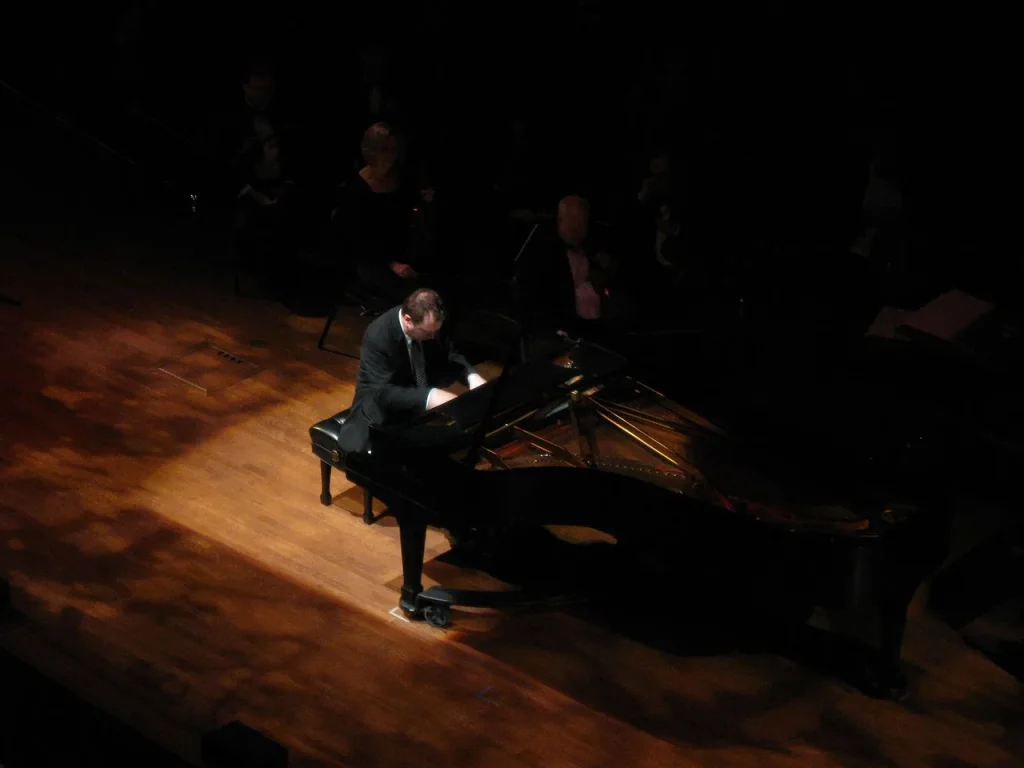
Claude Debussy, an iconic composer, left his mark on the history of music through his revolutionary approach. Regarded as a key figure of modernism, he pushed the boundaries of composition and interpretation.
In his works for piano, nuances play an essential role. They reveal the full richness of his sound world, where every detail matters. Debussy’s poetic expressiveness rests on bold harmonic innovations that transform every note into a tangible emotion.
This guide explores the technical and stylistic features of his repertoire. Through examples such as Pelléas et Mélisande, we decipher the secrets of an authentic interpretation. To learn more, see this in-depth analysis.
Introduction to Debussy’s Art
At the turn of the twentieth century, one composer redefined the boundaries of music. Claude Debussy, a major figure among the composers of his era, distinguished himself through bold innovations. His training at the Conservatoire from 1872 under Marmontel laid the foundations of his creative genius.
Debussy rejected strict academic rules, preferring to explore new forms of expression. His style, often described as “Impressionist,” revolutionized music. Inspired by Symbolists such as Mallarmé, he sought to transcend convention and create unique atmospheres.
Debussy’s Musical Revolution
Debussy broke with Wagnerian conservatism in search of freer, more expressive music. He used the piano pedals innovatively, creating rich, evocative sound textures. In pieces such as “Clair de lune,” silences and resonances play a central role, adding unrivaled emotional depth.
“I would like music that is like the passing wind.”
The Importance of Nuance in His Work
The 1889 Exposition Universelle had a decisive influence on Debussy. His discovery of Javanese gamelan enriched his musical language and allowed him to explore new sonorities. These influences are reflected in his work, where every detail is carefully considered to create an immersive experience.
Debussy’s Historical Context
Against a backdrop of cultural transformation, one composer stands out. Claude Debussy emerged at a time when music was seeking freedom from convention. The Parisian artistic milieu, rich in exchanges and innovation, played a key role in his development.
His stay at the Villa Medici between 1885 and 1887 marked a decisive beginning. The experience allowed him to distance himself from academic standards and explore new paths. It was also during this period that, through Ernest Chausson, he discovered Mussorgsky’s work—a revelation that would profoundly influence his style.
Debussy and Musical Renewal
Debussy firmly opposed post-Romantic academicism. He sought to create freer music that broke with tradition. His interest in Eastern elements, particularly in Estampes, demonstrates this desire for innovation.
His collaboration with Maurice Maeterlinck on Pelléas et Mélisande (1893–1902) illustrates this quest for originality. Marked by a dreamlike atmosphere, the work reflects his desire to transcend the musical limits of his time.
Influences and Inspirations
The Nabis painters, with their spatial and symbolic approach, also influenced Debussy. Their influence can be felt in his conception of music as an immersive experience. Parisian salons, places for meeting and sharing ideas, played a crucial role in popularizing his works.
Debussy also drew inspiration from Wagner while seeking to distance himself from him. He criticized Wagnerian grandiloquence, preferring a subtler and more nuanced expression. This tension between admiration and rejection shaped his unique style.
Debussy’s Stylistic Characteristics
Debussy’s musical approach is distinguished by a reinterpretation of ancient traditions. At the turn of the twentieth century, he incorporated historical elements to create a unique language. His writing rests on a bold exploration of medieval modes and innovative scales.
The Use of Medieval Modes
Debussy rediscovered the Dorian and Phrygian modes, incorporating them into works such as the Prelude to the Afternoon of a Faun. These modes, often associated with Gregorian music, bring an archaic color to his compositions. Unlike Berlioz, who used them dramatically, Debussy employed them to create dreamlike atmospheres.
In The Sunken Cathedral, the Hypodorian mode is used to evoke a mysterious atmosphere. This approach shows how Debussy transformed ancient elements into a modern form of expression.
The Whole-Tone Scale and Its Implications
The whole-tone scale, used in Voiles (Preludes I), is another major characteristic. This hexatonic structure creates tonal ambiguity, freeing the music from traditional constraints. The notes follow one another in whole tones, producing a fluid, evocative sound.
This innovation allowed Debussy to explore new harmonies, influencing the evolution of musical language in the twentieth century. It illustrates his quest for free and emancipated expression.
| Approach | Berlioz | Debussy |
|---|---|---|
| Use of modes | Dramatic and theatrical | Dreamlike and atmospheric |
| Whole-tone scale | Rarely used | Innovative and liberating |
| Harmonic impact | Conservative | Revolutionary |
The Art of Modulation in Debussy
Modulation, a key element in Debussy’s music, reveals the full complexity of his sound world. This composer transformed the technique into an expressive tool that enabled fluid, evocative transitions. His command of chord progressions and chromatic motion redefined harmonic possibilities.
Modulation Techniques
Debussy uses progressions of ninth and eleventh chords, as in Arabesque No. 1, to create rich textures. The chromatic motion found in Reflections in the Water adds unrivaled fluidity. These techniques contrast with Wagnerian modulations, which are more dramatic and linear.
Pivot notes, used in Children’s Corner, allow for subtle transitions. Pedal points also play a crucial role, stabilizing passages while enriching the harmony.
Examples in His Works
In The Hills of Anacapri, Debussy uses enharmonic modulations to create surprising effects. This approach influenced pianists such as Ravel and Messiaen, who adopted his innovations in their own works.
The prelude Voiles also illustrates his mastery of the whole-tone scale, freeing music from traditional tonal constraints. These examples show how Debussy pushed the limits of modulation to create unique atmospheres.
Debussy’s Harmonic Structure
Debussy’s harmonic structure marks a break with classical conventions. He explored innovative notes and modes, creating a unique musical language. His approach conveys a feeling of freedom and escape, far removed from the strict rules of his time.

In works such as The Fountain, Debussy omits the leading tone, producing a fluid and evocative sound. This technique demonstrates his desire to move beyond traditional frameworks. The augmented-fifth chords in La Mer likewise illustrate his harmonic daring.
Unconventional Harmonies
Debussy adopted a coloristic rather than functional approach. For example, the mysterious chord in Pelléas et Mélisande (Act III) creates a dreamlike atmosphere. Influenced by Japanese bells, his harmonies use clusters to evoke rich textures.
This exploration had consequences for the evolution of music, particularly Schoenberg’s atonality. Debussy opened the way to new harmonic possibilities, as this in-depth analysis demonstrates.
Avoiding the Leading Tone
Debussy often avoids the leading tone, creating fluid harmonic progressions. In The Fountain, its omission produces a sense of suspension that heightens expressiveness. This technique contrasts with Satie’s experiments, which favor simplicity.
By using varied meters and rhythms, Debussy pushed the boundaries of harmony. His legacy continues to inspire modern composers, bearing witness to his innovative genius.
The Role of Tempo in Interpretation
Tempo plays an essential role in interpreting Debussy’s works. It shapes atmosphere and expressiveness, allowing the pianist to convey the composer’s intentions. Debussy often left precise metronome markings, but performers vary in how they apply them.

For example, Debussy’s historic recording of Dancers of Delphi uses a tempo of 32 bpm, far slower than some modern interpretations. This difference highlights the importance of understanding the spirit rather than the letter of the markings.
Debussy’s Metronome Markings
Debussy often used metronome markings to guide performers. Yet there is a gap between these markings and performance practice. In Footprints in the Snow, for example, the rubato suggests a flexibility that numbers cannot capture.
The technical limitations of period Pleyel pianos also influenced tempos. Modern pianists must therefore adapt their playing to respect the spirit of the work while accounting for technological advances.
Tempo Variations in His Preludes
Debussy’s preludes perfectly illustrate tempo variation. In Fireworks, accelerandos create explosive momentum, while Footprints in the Snow relies on subtle rubato to evoke an icy atmosphere.
A comparative study of Cortot’s 1931 recordings and Gieseking’s 1953 recordings reveals different approaches. Cortot favors a freer tempo, whereas Gieseking follows the markings more strictly. These variations demonstrate the interpretive richness of Debussy’s works.
| Prelude | Suggested tempo | Cortot’s interpretation | Gieseking’s interpretation |
|---|---|---|---|
| Dancers of Delphi | 32 bpm | Slow and expressive | Moderate and precise |
| Footprints in the Snow | Free | Pronounced rubato | Subtle rubato |
| Fireworks | Accelerandos | Explosive energy | Controlled |
Expressiveness in Debussy’s Compositions
Debussy’s expressiveness rests on a subtle command of nuance. Each composition is an emotional journey in which the pianist must capture the essence of every note. Dynamics ranging from ppp to ff play a central role in this expressiveness.
In works such as The Joyous Island, contrasts between gentleness and intensity create compelling tension. Directions such as “gentle and expressive” in The Girl with the Flaxen Hair guide the performer toward an interpretation faithful to Debussy’s spirit.
Nuance and Dynamics
The “attackless” piano-touch technique is essential for reproducing these nuances. It creates fluid sounds while avoiding any harshness. Resonances in the arpeggios must be carefully managed to preserve the balance of the sound.
The sostenuto and una corda pedals play a key role. The sostenuto pedal sustains the low notes, while the una corda pedal softens the sound, adding another dimension to the expressiveness. The Durand and Henle editions offer different perspectives on these techniques, enriching interpretation.
The Importance of Phrasing
Phrasing in Debussy is an art in itself. It requires a deep understanding of the feeling behind each phrase. In his accounts, Gieseking emphasizes the importance of legato in reproducing Debussy’s characteristic fluidity.
Harmonic progressions and silences must be handled carefully. They help create a coherent musical form in which every element fits perfectly. This approach conveys the full emotional richness of Debussy’s music.
Debussy’s Influence on Modern Music
Debussy’s musical legacy continues to resonate in the contemporary world. His innovative approach opened new horizons, influencing composers across genres and eras. As Pierre Boulez said:
“Debussy liberated French music.”
This liberation made limitless exploration possible, marking a turning point in the twentieth century.
Impact on Contemporary Composers
Debussy inspired artists far beyond classical music. In jazz, Bill Evans incorporated his complex harmonies into his improvisations. Philip Glass’s minimalism also echoes Debussy’s aesthetic through its repetitive, atmospheric quality.
Film composers such as Alexandre Desplat have adopted his modes to create unique cinematic atmospheres. This influence shows how Debussy transcended musical boundaries to become a reference point for many types of creation.
Debussy’s Legacy in Classical Music
In classical music, Debussy played a key role in the evolution of teaching. His works are now part of conservatory repertoires, training new generations of musicians. The electroacoustic avant-garde has also rediscovered his work, exploring his sound textures in a modern context.
Recent exhibitions, such as the one held at the Musée d’Orsay in 2020, have celebrated his legacy and recalled his importance in music history. These initiatives attest to the lasting nature of his influence, even a century after his death.
| Field | Debussy’s influence |
|---|---|
| Jazz | Complex harmonies (Bill Evans) |
| Minimalism | Atmospheric repetition (Philip Glass) |
| Film music | Modes and atmospheres (Alexandre Desplat) |
| Teaching | Inclusion in conservatory repertoires |
Analysis of Debussy’s Preludes
Debussy’s preludes offer a deep immersion in his sound world. Each piece is a unique exploration that reveals his mastery of nuance and texture. Although often short, these works are rich in detail and emotion.
“Dancers of Delphi”: A Case Study
The prelude Dancers of Delphi is a perfect example of an ABA’ arch form. This form allows Debussy to create a balance between tension and resolution. The dissonances in measures 8 and 9 add a touch of mystery typical of his style.
His handling of harmonic pedaling is also remarkable. Debussy uses the sostenuto pedal to sustain the low notes, creating a rich resonance. This technique illustrates his innovative approach to the instrument.
Comparing Interpretations
Recordings by Gieseking and Cortot reveal different approaches. Gieseking uses an average tempo of 34 bpm and favors precision. At 37 bpm, Cortot opts for a freer, more expressive interpretation.
The acoustics of the recording venues also influenced these versions. Editorial choices in modern urtext editions reflect these nuances, offering pianists varied perspectives for their interpretations.
| Performer | Tempo (bpm) | Approach |
|---|---|---|
| Gieseking | 34 | Precision and clarity |
| Cortot | 37 | Freedom and expressiveness |
Interpretive Techniques for Pianists
Interpreting Debussy’s works calls for a unique technical and emotional approach. Every musician must master specific methods to reproduce the richness of his writing. These techniques, ranging from managing polyrhythms to the strategic use of pedals, are essential to an authentic interpretation.
Approaches to Playing Debussy
In his book The Art of Piano Playing, Walter Gieseking proposes a method based on hand independence. This technique provides greater control over complex textures, particularly in pieces such as “Gardens in the Rain.” Separate exercises for the left and right hands are especially useful when tackling polyrhythms.
The middle pedal plays a key role in creating resonance. Used strategically, it sustains low notes while softening the harmonies. This approach is essential for reproducing Debussy’s characteristic dreamlike atmosphere.
Advice for Mastering Nuance
Working on micro-intervals in scales is another crucial aspect. These subtle details add emotional depth to an interpretation. Pianists must also adapt their playing to modern instruments while respecting the spirit of period pianos.
C. Bavouzet’s master classes offer valuable recommendations for meeting these challenges. These sessions allow musicians to refine their technique and better understand the composer’s intentions.
| Technique | Application |
|---|---|
| Hand independence | Control of complex textures |
| Middle pedal | Creation of resonance |
| Micro-intervals | Emotional depth |
| Adapting to modern pianos | Respecting the period spirit |
Historic Recordings of Debussy
Historic recordings of Debussy offer a unique insight into the interpretation of his music. Made by legendary pianists, these recordings provide a better understanding of his style and intentions. They also reveal how recording techniques evolved over time.
Recordings by Alfred Cortot
Alfred Cortot, one of the greatest interpreters of Debussy, left behind landmark recordings. His 1931 version is distinguished by expressive rubato, contrasting with the rhythmic rigor of his 1949 takes. These variations show how the same pianist can adapt his playing over time.
Accounts of his recording sessions reveal meticulous attention to detail. Cortot sought to capture the essence of every measure, offering an interpretation rich in emotion.
Recordings by Walter Gieseking
Walter Gieseking, known for his technical precision, recorded Debussy’s works in 1953. His slow tempo (31 bpm) for Dancers of Delphi illustrates his thoughtful approach. Gieseking favored clarity and fluidity, creating timeless interpretations.
Recent digital restorations have made it possible to rediscover these recordings with improved sound quality. They offer a fascinating example of the evolution of recording techniques.
| Performer | Year | Style |
|---|---|---|
| Alfred Cortot | 1931 | Expressive rubato |
| Alfred Cortot | 1949 | Rhythmic rigor |
| Walter Gieseking | 1953 | Slow, precise tempo |
Conclusion: The Art of Nuance in Debussy’s Piano Music
The legacy of Claude Debussy transcends eras, marking a turning point in the history of music. His technical and aesthetic innovations redefined expressive possibilities and influenced generations of composers. His sensory approach, in which every detail matters, invites us to rediscover his autograph manuscripts and grasp the full depth of his genius.
His impact remains tangible in contemporary music. Artists from many backgrounds continue to draw inspiration from his unique language, attesting to his enduring legacy. As Debussy said: “Music is the space between the notes.” This thought sums up his art, in which emotion arises from the balance between silence and sound.